

J-Village opened in 1997 as Japan's first national training center for soccer in Fukushima. In its 15th year of operation, the Great East Japan Earthquake struck in March 2011, and J-Village, a sacred place for soccer, was unexpectedly handed the important mission of being the logistics support base for post-disaster restoration efforts.
After fulfilling this mission, operations as a national training center fully resumed in April 2019, only for the center to be confronted with another crisis: the COVID-19 pandemic. Having overcome these two ordeals, J-Village is beginning to take on new challenges with the local community and its partners, including Hitachi. It is a symbol of the revitalization of Fukushima and a hub for communicating the attractions of the region through sports.
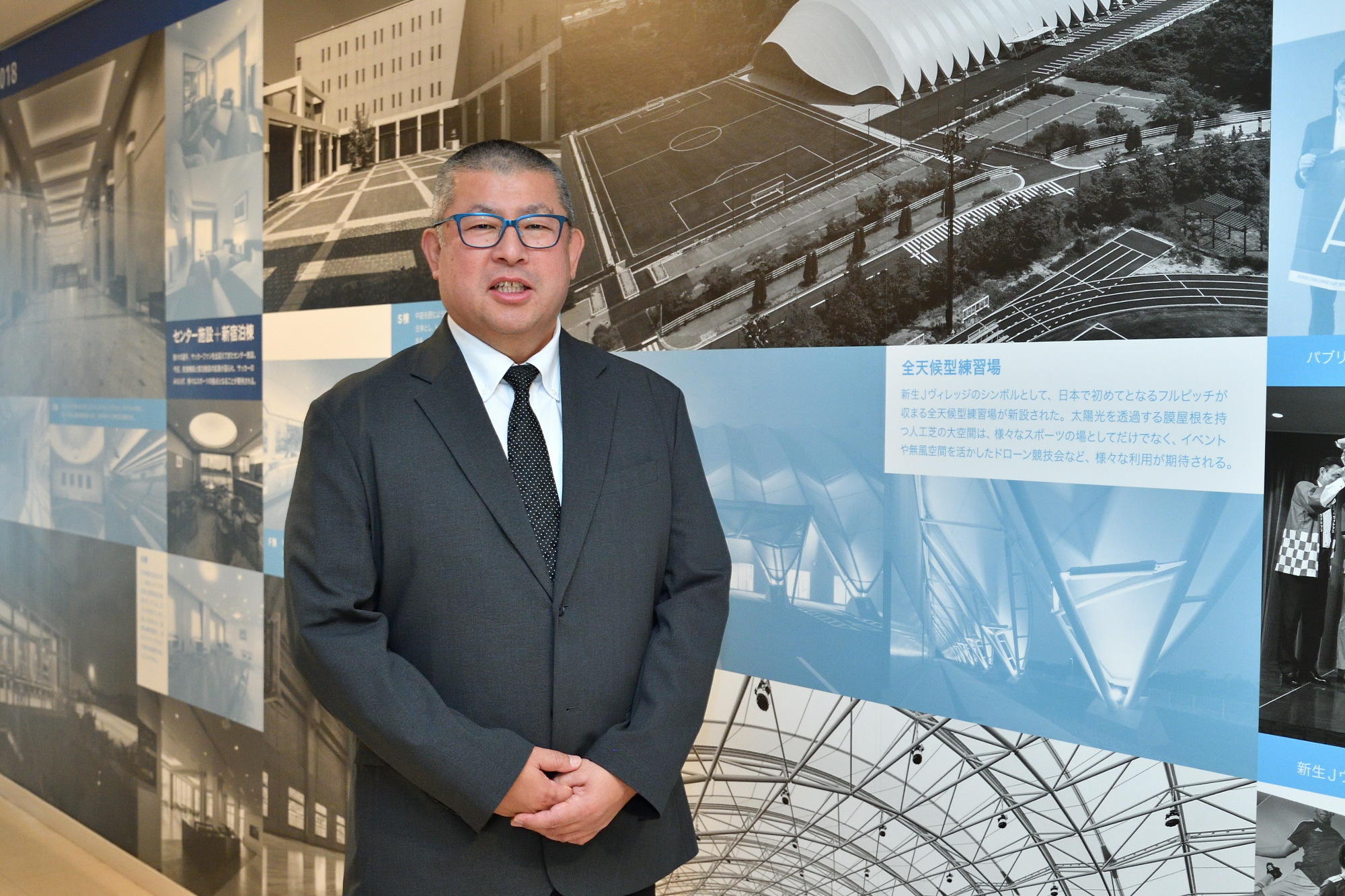
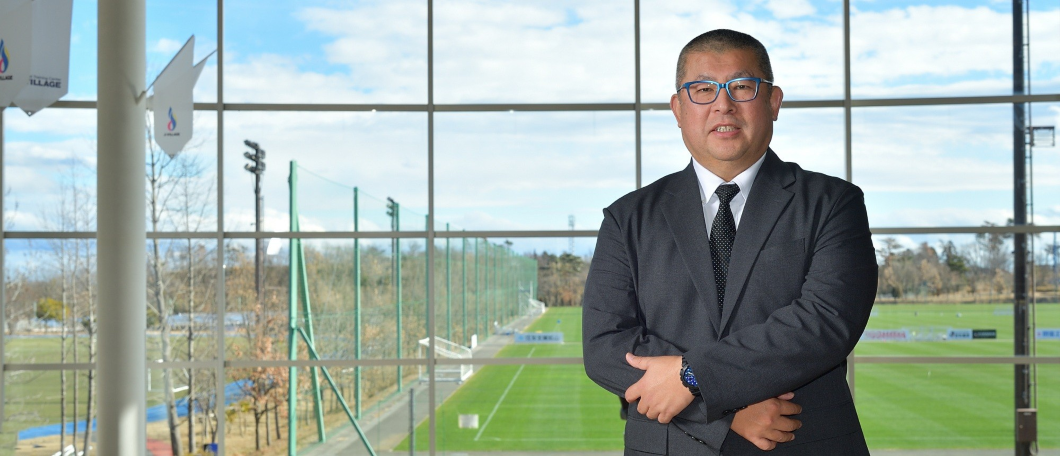
We visited J-Village, which is now brimming with energy, and interviewed its director Fumihiro Mizoguchi about the many different roles that J-Village has played, what they are doing now and their future developments and aspirations.
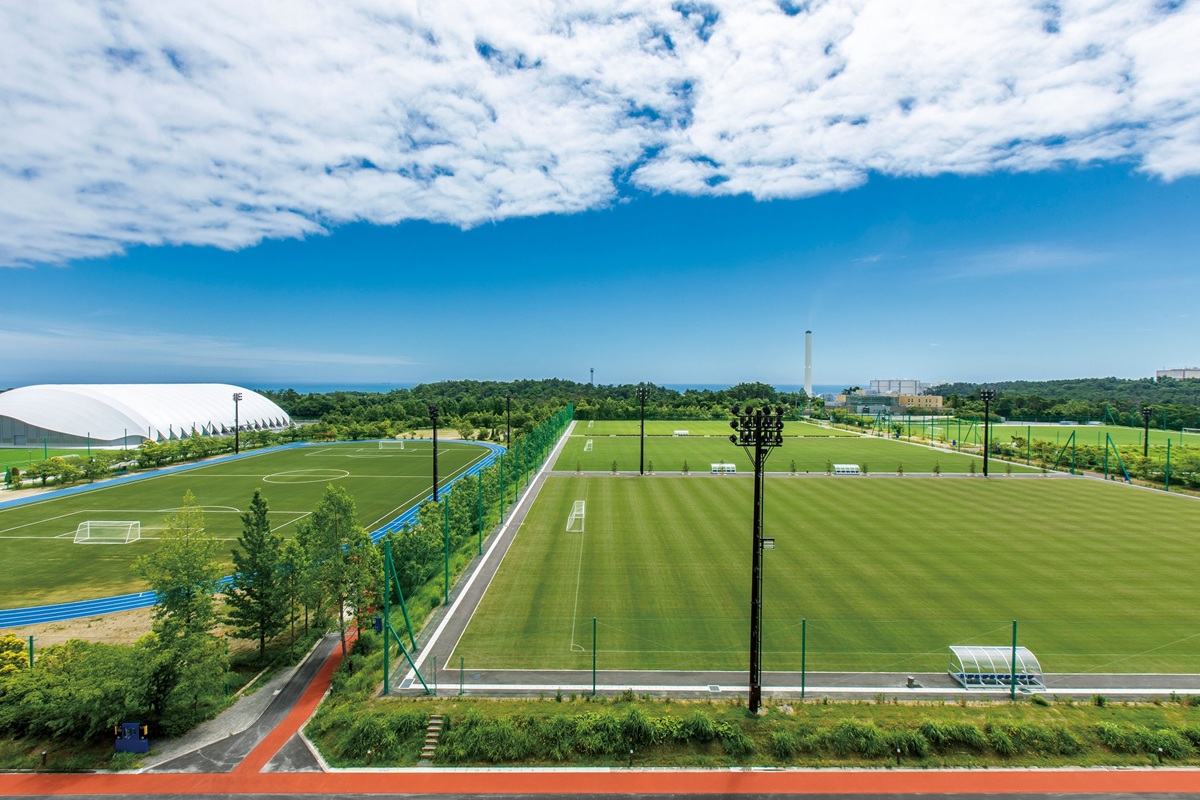
J-Village (Naraha-machi and Hirono-machi, Futaba-gun, Fukushima Prefecture) opened in July 1997. It was expected that the completion of the national training center with eleven world-class natural turf pitches would trigger regional revitalization and contribute to the world of sports.
With what is known in Japan as the “agony of Doha” still vivid in memory, the Japan Football Association wanted to create a soccer-specific training center modeled after German sports academies. At that same time, Tokyo Electric Power Company Holdings, Inc. (TEPCO), which had its own power plant in Fukushima, was exploring what it could do to truly contribute to the local community, and both organizations' wishes were aligned.
Mr. Fumihiro Mizoguchi began explaining the facility's history. He transferred from TEPCO to J-Village, and he has already been working at J-Village longer than he worked for TEPCO.
After J-Village opened, it hosted the camps of Japan's national soccer team and some J-League clubs. It was also the official base camp of Argentina's national team for the 2002 World Cup in Japan and Korea. In 2006, Japan's national soccer team stayed there for its last domestic camp before the World Cup in Germany. J-Village grew to be widely known as a sacred place for soccer. In addition to hosting the national team's camps, J-Village is also home to numerous national tournaments at all levels of sport, including the national youth soccer tournament. Most notably, J-Village greatly boosted the development of the world of soccer by enabling people to see top players up close.
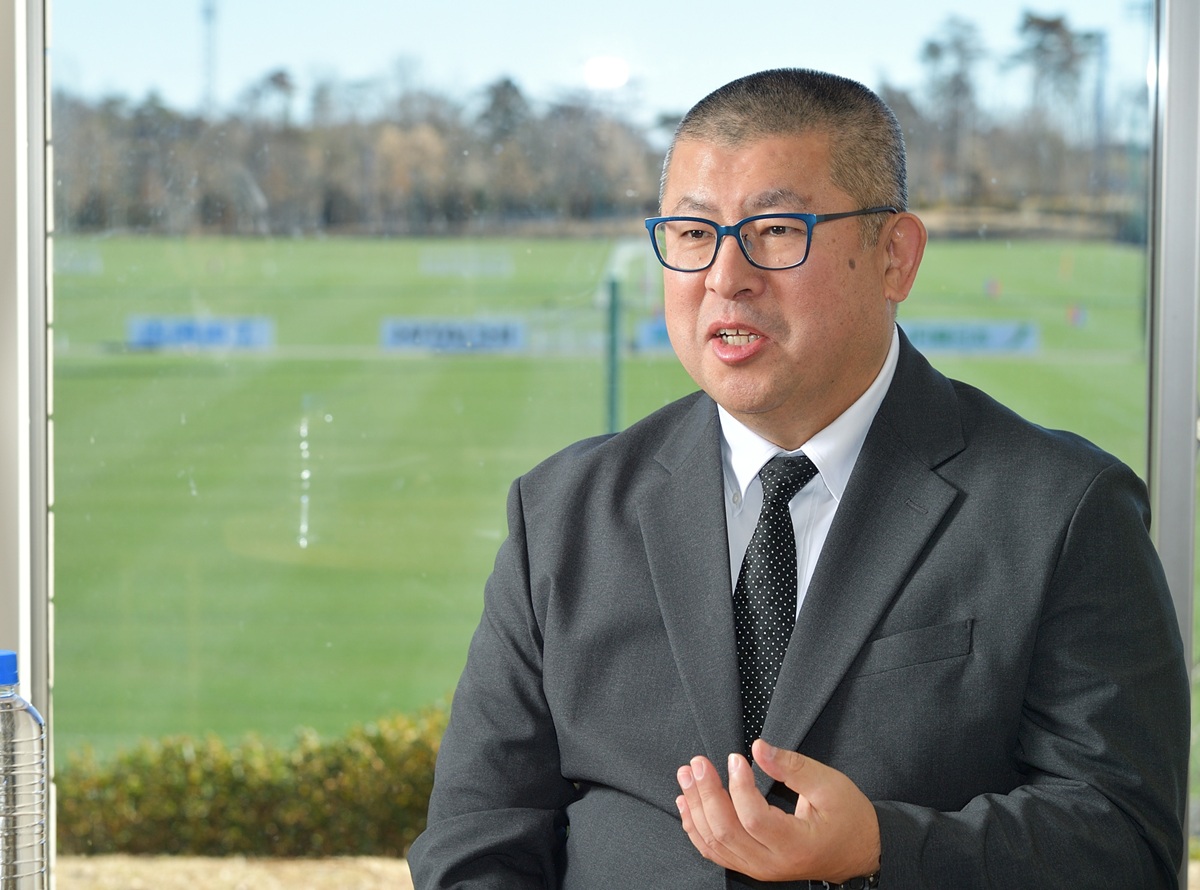
Fumihiro Mizoguchi, Director of J-VILLAGE, Inc.
Amidst these activities, J-Village, which is in Fukushima, was hit by the Great East Japan Earthquake, which caused unprecedented damage, on March 11, 2011. Located on high ground 40-50 m above sea level, J-Village was luckily unaffected by the tsunami, and the damage to its buildings was minor. However, the big earthquake cracked some of the pitches and the roads around the facility were damaged significantly. The earthquake also rendered the water and sewer services unusable. The facility's infrastructure was heavily damaged.
At that time, J-Village was home to TEPCO Mareeze, TEPCO's women's soccer club. When the earthquake occurred, the Mareeze were in Miyazaki for camp. Mr. Mizoguchi, the manager of the team at that time, was not in J-Village when the earthquake hit. “It was pitch black and very cold, but the staff worked together to get through the sudden challenge. They handed blankets and bench coats to people who evacuated to the fields,” he recalled about the day of the disaster.
On the following day, March 12, the area within a 20 km radius of Fukushima Daiichi Nuclear Power Station was designated as an evacuation zone after the accident at the power station, and J-Village became the frontline operational base for post-disaster restoration activities in Fukushima.
“We were very close but outside the evacuation zone. A decision was quickly made to use J-Village as a hub for bringing the accident under control. The facility became a battlefield. Armored vehicles from the Self-Defense Force, fire trucks, police cars and other vehicles gathered on the premises, and full-face masks, protective clothing and other equipment were scattered throughout the building,” said Mr. Mizoguchi.
Crushed stone was laid over the natural turf pitches, which then became a parking area for the workers responding to the disaster. Roofed spaces became warehouses and every piece of flat ground was occupied by a temporary building. The remodeling of the facility into a disaster response logistics support base was largely completed in 2012. By May 2014, J-Village had fulfilled its mission, and the J-Village reconstruction project was formed, starting the efforts to restart soccer operations at the facility.
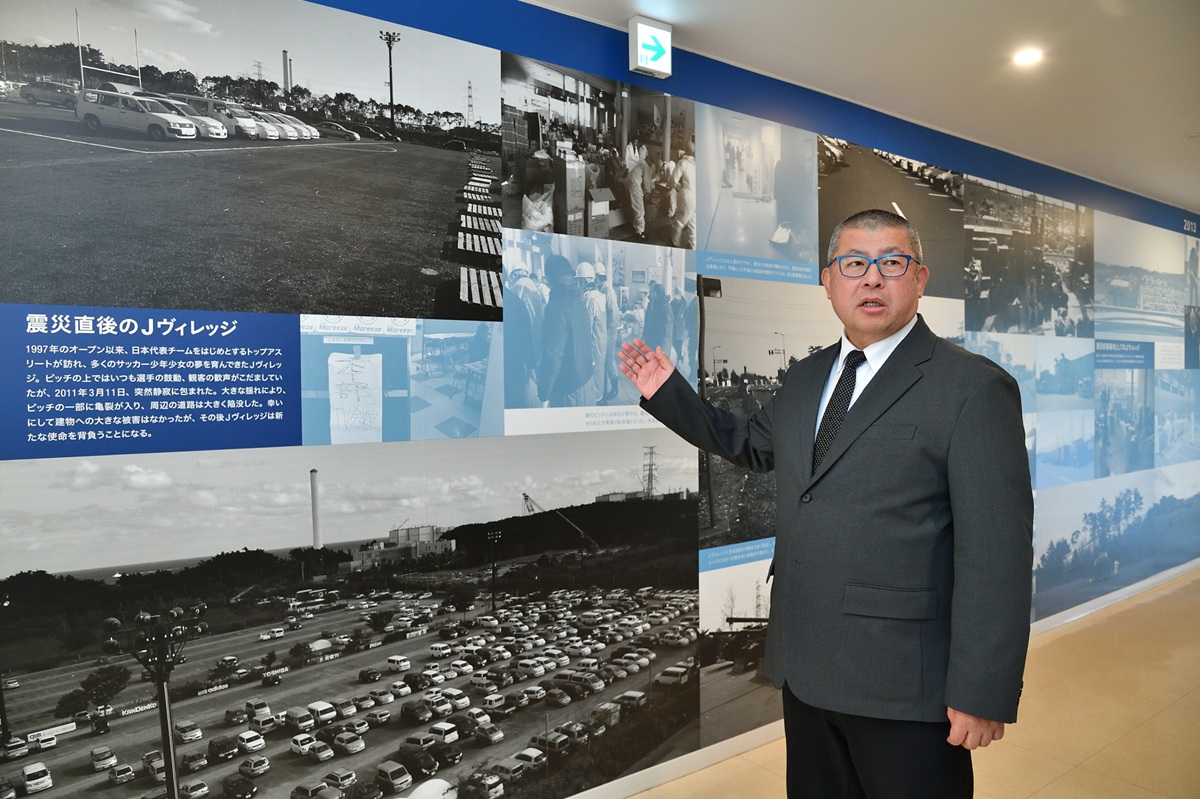
In July 2018, J-Village began to restart its sports operations more than seven years after it had been forced to stop.
When planning the restart, J-Village also planned to increase its capabilities beyond just restoring the facility to what it had been before the disaster. This included converting one pitch to artificial turf and building an all-weather practice field and a new accommodation building, and expanding its restaurant and kitchen facilities. With its improved facilities, J-Village can host various sporting events on its all-weather practice field and accommodate up to 470 guests. The new fully equipped accommodation building includes a banquet hall, and it can also be used for business events.
During the renovation of J-Village, the goal was to resume sports operations before the start of the Tokyo Olympic and Paralympic Games so that countries' teams could use it as a practice facility before the Olympic Games. Due to the COVID-19 pandemic, the Olympics were postponed one year, but the initial goal was achieved as the facility resumed operations in 2018. J-Village hosted Japan's national basketball team during their camp in preparation for the Tokyo Olympics. The torch relay started at J-Village before going all over the country, helping to energize the first Summer Olympics to be held in Japan in 57 years.
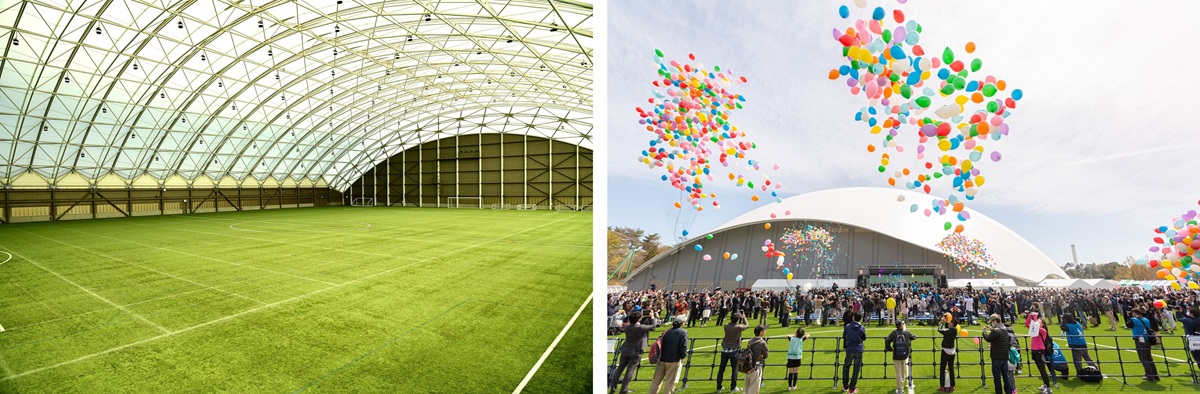
All-weather practice field (left) and the ceremony celebrating J-Village resuming sports operations (right)
One of the changes after J-Village resumed sports operations was its solidification of its partnerships with local governments and businesses. J-Village Station opened in April 2019 with Fukushima Prefecture, eight local municipalities and the East Japan Railway Company sharing the cost of station maintenance, further increasing J-Village's cooperation with the local municipalities.
“J-Village believes that a vital part of its role is to plan and run major events showcasing the revitalization of Fukushima to both Japan and the world in partnership with the local municipalities,” says Mr. Mizoguchi.
As the region continued its recovery, J-Village was the base camp for Argentina's national rugby team during the World Cup and it hosted events including the J-Village Grand Open Festival and Futaba World 2019 in J-Village in that same year.
However, J-Village faced another crisis in 2020 as the COVID-19 pandemic began. At its lowest point, 27,000 guests cancelled their reservations in a single year, severely impacting J-Village, which had only recently begun to recover from the earthquake. However, the ordeal unified J-Village and its stakeholders and motivated them to overcome this disaster together.
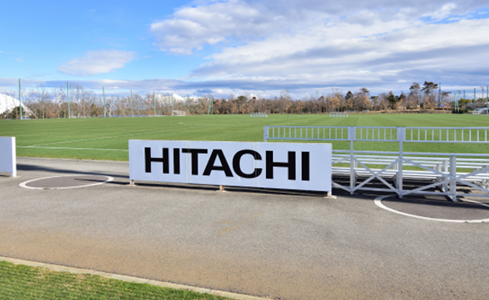
“Despite the difficult business conditions due to the COVID-19 pandemic, we were supported by Hitachi, Ltd., the Hitachi Group and many small and medium-sized companies, as well as the local municipalities, and we are very grateful for this support.
We use digital signage and other methods to share information about these companies and sponsors, but we are a long way off from returning the favors they've done for us,” said Mr. Mizoguchi.
J-Village has been trying new things in recent years. Conventionally, J-Village has used posters and flyers to announce its half-marathon. The facility began announcing the event on social media, and the number of participants from across the country increased rapidly. As the number of inbound tourists is increasing, it is necessary for J-Village to go beyond multilingual services and provide enhanced hospitality services considering the differences in people's cultures and customs, including serving vegan and other special meals when guests provide advance notice.
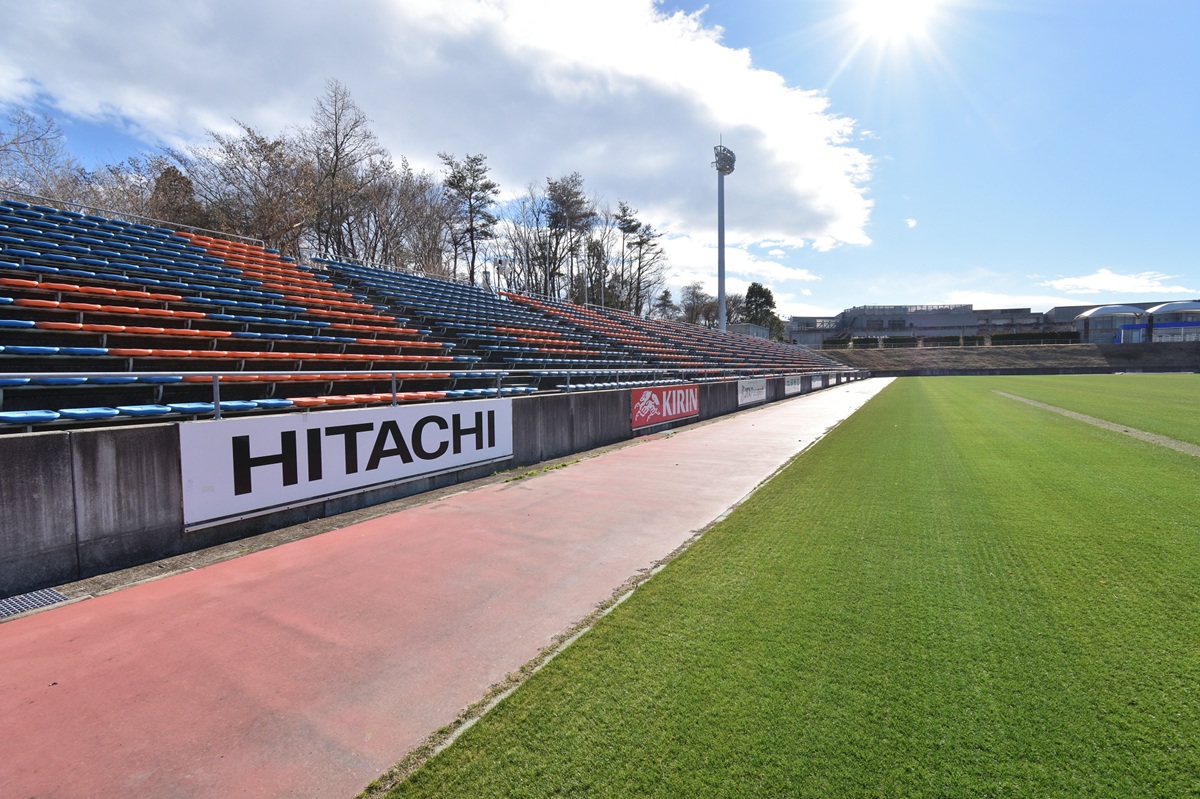
Amid the efforts to revitalize the region through sports by increasing the number of visitors to the region, dispelling people's negative perceptions and returning to the vibrancy of pre-disaster Fukushima, J-Village emphasizes the preservation of the fading memories of the disaster and contributions to the ongoing revitalization of the region.
Taking advantage of its location close to Fukushima Daiichi Nuclear Power Station, J-Village offers educational tours and corporate training programs, such as Disaster Lectures that communicate the realities and lessons learned from the earthquake and tsunami, and programs based on the experience gained in the management of evacuation shelters during the disaster. Because it is close to many facilities related to the nuclear disaster and recovery efforts, J-Village hosts visitors and provides lessons learned from the disaster which cannot be taught anywhere else.
Some of the more unique programs can only be experienced at this sacred place for soccer.
Explains Mr. Mizoguchi, “We offer experiential programs including blindfolded soccer, where players are blindfolded, and walking soccer, where running and physical contact are prohibited. J-Village's unique experience programs enable teams to strategize and increase communication in an enjoyable and energetic environment, and they are used for new employee training and other purposes.”
When asked about future plans, he responded, “We are focusing on steady, low-profile activities rather than high-profile initiatives that require significant money, people, or time.” In the upcoming Fukushima Destination Campaign, the facility will communicate the attractiveness of Fukushima to the whole country using the corporate slogan, “Make an impressive moment into a lifelong memory,” as it works with the local community and its partners to revitalize the region. In recent years, J-Village has been used as a base for demonstrating cutting-edge technologies, including drone test flights and the demonstration of next-generation solar cells.
Going forward, J-Village will support the next phase of the regional revitalization activities and continue to lead the revitalization of Fukushima by actively taking on new challenges and communicating the attractiveness of J-Village, the local community and its partners while expanding its trust-based relationships with a wide range of stakeholders. The goal is to steadily move forward, step by step, on a journey toward revitalization.