Hitachi’s Research & Development Group is advancing research and development of the Integrated World Infrastructure Model (IWIM), which integrates the knowledge Hitachi has accumulated in social infrastructure with AI technologies. Hitachi positions IWIM as a core technology for realizing a “Social Infrastructure OS” that supports the autonomous evolution of social infrastructure, with the aim of applying it to social infrastructure in the era of Physical AI.
To operate social infrastructure safely and reliably, it is necessary to do more than identify trends from data. Decision-making must also take into account how equipment and systems work, the physical phenomena involved, OT (Operational Technology) knowledge related to the control and operation of social infrastructure and equipment, and the conditions required for social implementation.
IWIM models these real-world mechanisms, phenomena, and knowledge in forms that can be used to understand and reproduce the real world and predict future states. By integrating physical laws and engineering models, OT knowledge, and knowledge related to social implementation, IWIM supports decision-making based on a comprehensive view of complex social systems.
IWIM is not a single AI model. Rather, it is an integrated intelligence foundation that combines multiple physics models and knowledge models with different roles according to the purpose and situation, enabling Physical AI systems to operate safely and reliably in the real world.
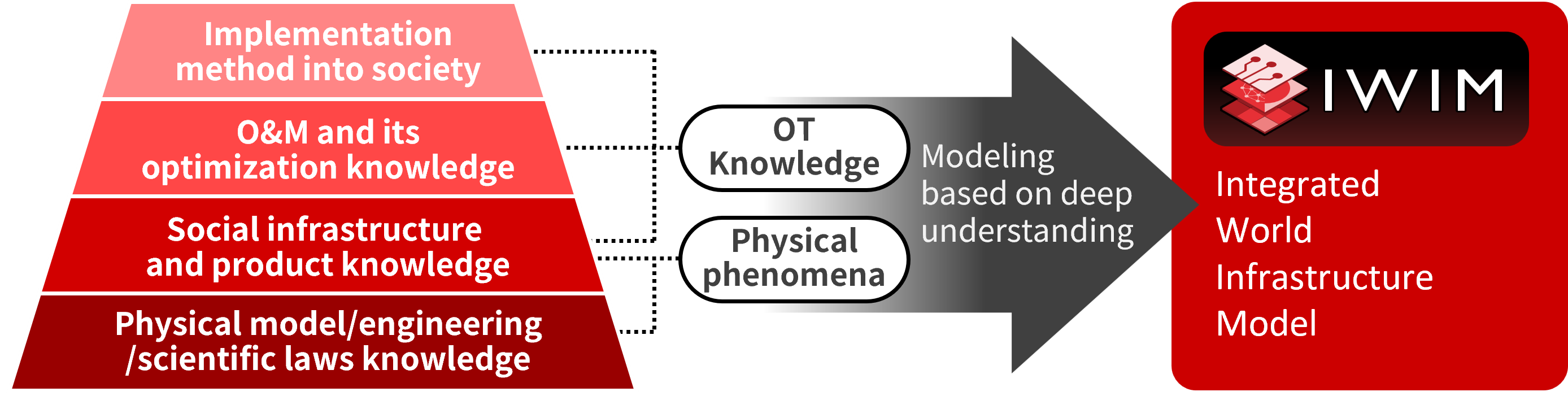
IWIM is built by modeling knowledge of physical phenomena, social infrastructure, operations and maintenance, and social implementation based on a deep understanding of the real world.
Notes:
*Model (modeling): Representing real-world mechanisms, phenomena, and knowledge on a computer so that they can be used to understand and reproduce the real world and predict future states.
*OT (Operational Technology) knowledge: Knowledge related to technologies for controlling and operating social infrastructure and equipment.
Introducing the concept of IWIM and its role in social infrastructure in the era of Physical AI.

IWIM consists of physics models that represent the real world through physical laws and simulations, and knowledge models that represent expert knowledge, deployment approaches, and other knowledge.
Physics models include world foundation models, digital twins, simulators, and other models that represent states and changes in the real world. Knowledge models include expert knowledge accumulated through the operation and maintenance of social infrastructure, as well as knowledge related to deployment approaches.
Agentic AI selects and orchestrates these models according to the purpose and situation, enabling them to act as one. This allows IWIM to predict and evaluate how measures proposed by a Physical AI system could affect the real world. The evaluation results are returned to the Physical AI system and used for decision-making and control.
In this way, rather than applying measures generated by AI directly to the real world, IWIM evaluates their potential impact using both physics models and knowledge models, thereby supporting the safety and reliability required for social infrastructure.
Notes:
World foundation model: An AI model that learns and represents the physical behavior of the real world and is used to predict future states and perform simulations.
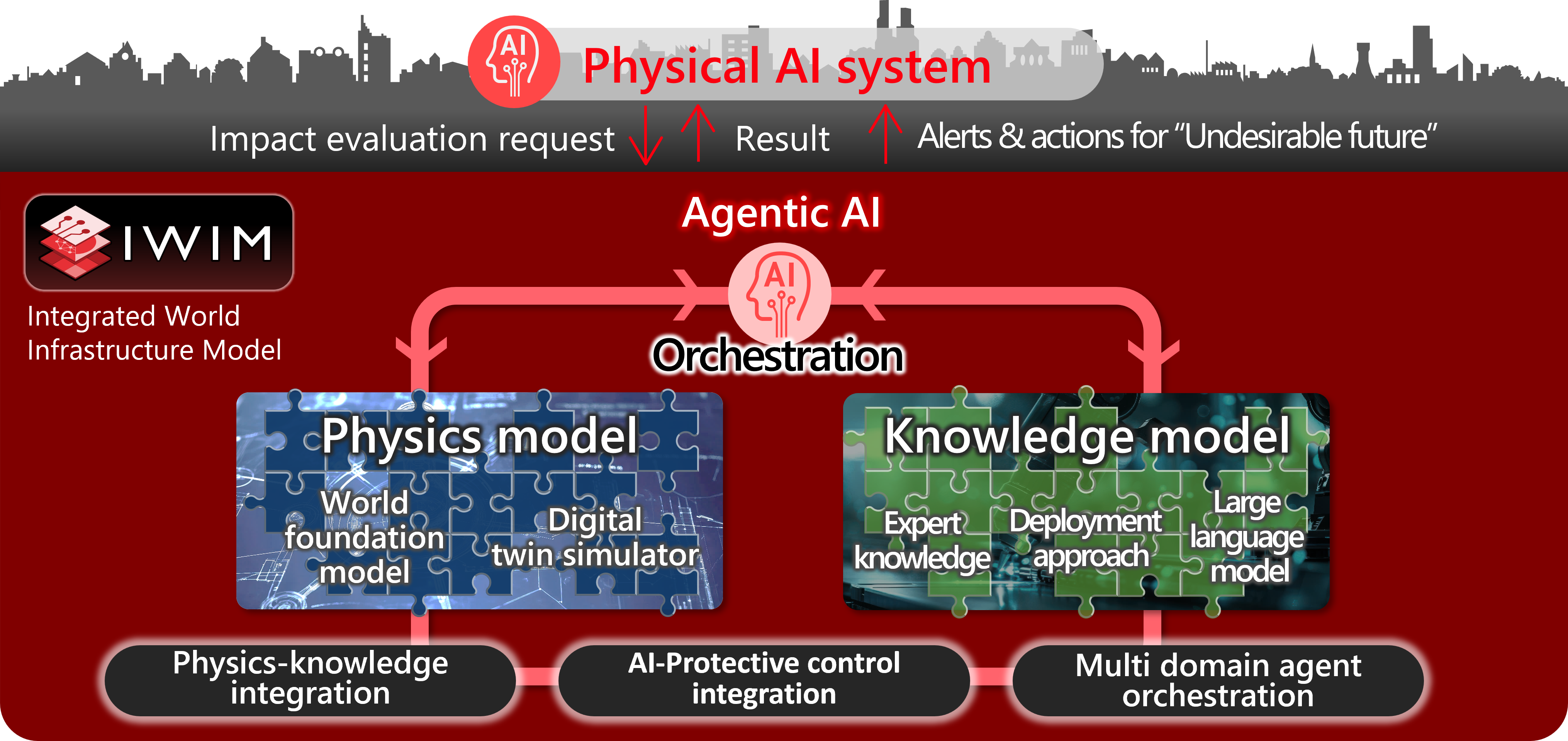
Agentic AI orchestrates physics models and knowledge models to evaluate the impact of proposed measures and support decision-making by Physical AI.
IWIM combines a deep understanding of the real world with AI technologies to support the safe and reliable operation of complex social infrastructure. At its core are three technologies.
Combining physical phenomena and operational knowledge to understand the real world
IWIM integrates physics models, including world foundation models, digital twins, simulators, and other models, with knowledge models that incorporate expert knowledge and deployment approaches.
Rather than relying solely on data, IWIM combines physical laws, knowledge of how equipment works, and expertise in operations and maintenance to understand real-world conditions and predict future states.
Combining AI-driven decision-making with the safety required for social infrastructure
IWIM uses physics models and knowledge models to predict and evaluate the impact of AI-generated measures on social infrastructure. It also validates and corrects AI-generated decisions from a safety perspective. If an undesirable future is predicted, the system can trigger alerts and actions.
In this way, IWIM supports both the use of AI and the safety and reliability required for social infrastructure.
Connecting models and knowledge across different domains
IWIM connects models and knowledge across different social infrastructure domains, including energy, mobility, data centers, manufacturing, and logistics.
Agentic AI orchestrates these models and knowledge according to the purpose and situation. This enables IWIM to address complex challenges spanning multiple social infrastructure domains rather than optimizing each domain individually, supporting decision-making across domains.
One of IWIM’s key characteristics is its ability to address challenges not only within individual social infrastructure domains but also across different domains.
Hitachi aims to apply IWIM across a wide range of social infrastructure domains, including energy, mobility, data centers, manufacturing, and logistics. Rather than simply advancing individual domains, IWIM connects models and knowledge across different areas, enabling interdependent social infrastructure systems to be considered as an integrated whole and supporting solutions to challenges that span multiple domains.
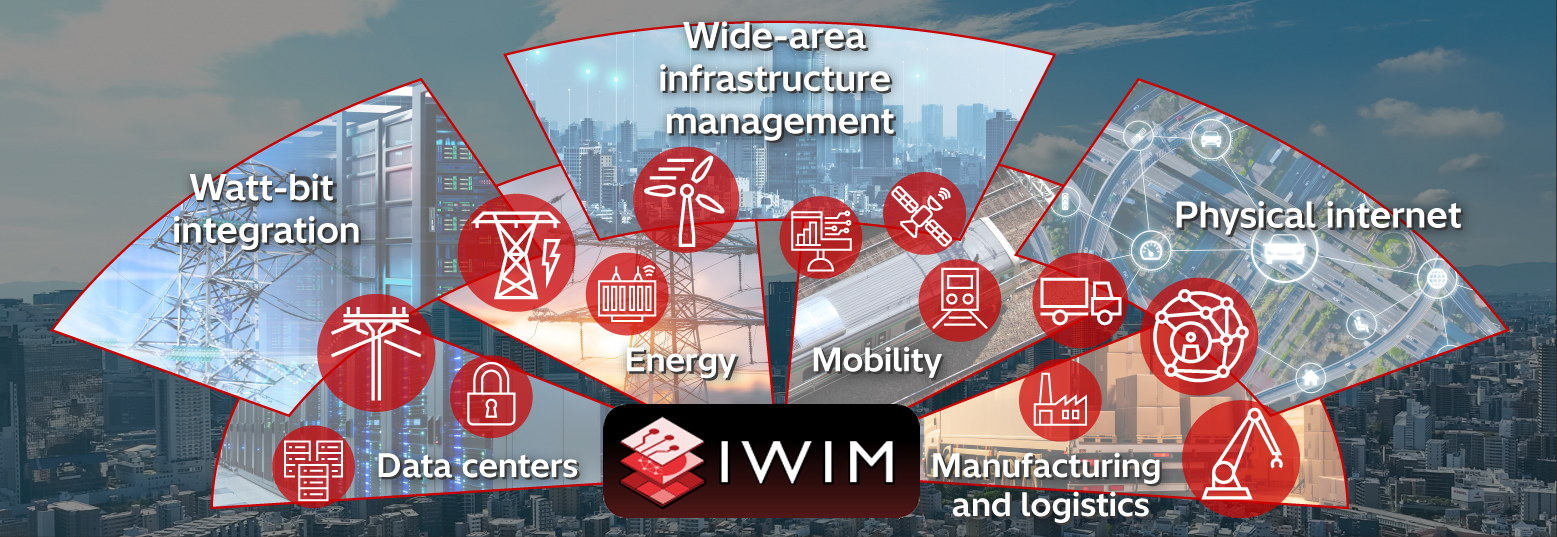
rom advancing individual social infrastructure domains to solving challenges across domains.
 Use case:
IWIM links data center computing resources with energy supply and demand, exploring the potential for integrated operation across the two domains.
 Use case:
IWIM connects models and knowledge related to mobility and energy, supporting operation and control across multiple social infrastructure domains.
 Use case:
IWIM captures the interrelationship between logistics and energy, supporting an integrated approach to the flow of goods and energy use across domains.
Learn more about the IWIM concept, architecture, core technologies, and applications.