




From the Outside, In: Designing the Next Generation of AI-Powered Grid Solutions
By Bo Yang, Vice President, Energy Solution Lab, Hitachi America, Ltd. R&D, and
Bret Toplyn, Director of Product Management Energy Analytics, Hitachi Energy
The energy industry is at a turning point. The rise of renewable energy, combined with the rapid growth of AI-driven data center loads, is placing unprecedented strain on the power grid. Meeting this challenge isn’t just about keeping up with demand; it’s about building the foundation for a more sustainable and resilient future.
Yet many of the grid analytics tools still in use today were designed decades ago. While functional, they are often cumbersome and unintuitive. They are ill-suited to the speed, complexity, and expectations of today’s AI-driven environment. These legacy systems present three major challenges:
- Outdated user experience – Interfaces are complex and difficult to navigate, creating barriers to adoption among new engineers
- Limited visualization – While data may be comprehensive, insights are not easily surfaced or communicated
- Barriers to talent – The next generation of engineers expects tools that are intuitive, engaging, and aligned with the digital experiences they already know
Modernizing these tools is not a luxury—it’s a necessity. As the grid evolves, so must the systems that we use to plan, manage, and optimize it.
AI-Powered Solutions in Action
At Hitachi, we’ve developed an AI-powered tool that a major U.S. grid operator believes could reduce interconnection study times by as much as 80 percent, a game-changing step toward faster integration of renewable energy and data center loads.
But that’s just the beginning. To truly modernize grid planning and operations, these tools must be as intuitive as they are intelligent, designed not only to perform complex tasks, but to empower the engineers and operators who use them every day.
Collaborating with Stanford Students: An Outside-In Approach
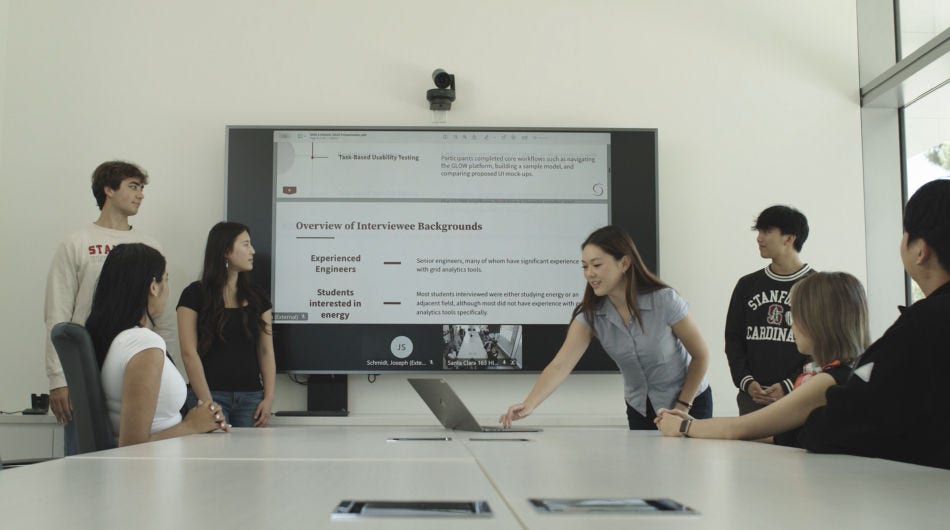
To better understand the needs of tomorrow’s energy professionals, we collaborated with a student organization, Stanford Management Group (SMG). A student-run consultancy at Stanford University, SMG’s task was to help us explore what both aspiring and experienced grid engineers expect from the next generation of analytics tools.
Over the course of ten weeks, the SMG team conducted 25 in-depth interviews with undergraduate and PhD students, as well as veteran grid operators across the U.S. Their findings revealed important generational and functional distinctions:
- Younger engineers want robust onboarding, interactive tutorials, and AI-powered assistance to help them navigate complexity
- Experienced operators prioritize speed and control—favoring advanced features like map-based search, results filtering, and real-time diagnostics.
- Across the board, users emphasized the importance of intuitive design, responsive interfaces, and consistent visual language.
One of the most compelling and widely supported ideas was the introduction of an AI chatbot—a tool that could support both onboarding and real-time decision-making, bridging the gap between experience levels.
Designing With People, Not Just For Them
In the past, professional software was often developed from the inside out: engineers built the technology, then expected users to adopt it. With this project, we took the opposite approach—starting with the user’s experience, then designing technology to support it.
That shift led to insights we wouldn’t have surfaced otherwise. For example, even something as simple as navigating a map to find a substation was cited as a common pain point. By rethinking search, layout, and information flow, we were able to improve usability and reduce friction.
Perhaps more importantly, the collaboration reminded us that future grid professionals are already forming expectations today—not just in universities, but in high school and even middle school STEM programs. If we want to empower them to lead the next energy transition, we need to build tools that meet them where they are.
Intelligent. Collaborative. Sustainable.
Our work with the Stanford team reinforced a critical lesson: grid modernization is not just a technical challenge—it’s a human one. And addressing it requires more than advanced algorithms; it requires empathy, collaboration, and a deep understanding of how people learn, work, and innovate.
At Hitachi, we believe AI-powered grid optimization will be key to achieving a sustainable energy future. But to realize that vision, we must co-create solutions with the people who will use them, designing tools that make complex work simpler, faster, and more meaningful.
Because when we put people at the center of innovation, we don’t just accelerate progress. We inspire what comes next.
What Trust Really Looks Like
Across all these applications — repair, diagnostics, inspection, robotics — one principle ties everything together: trust is earned, not assumed.
That’s why our systems make suggestions, not decisions. The worker stays in control. The AI learns from the worker, not the other way around. And we never position our tools as surveillance or control mechanisms. They’re there to assist, not oversee.
Even the way we deploy these tools matters. We spend time onsite, working with field teams and leadership to integrate AI into existing workflows. We explain what the system sees, and what it doesn’t. We take feedback seriously, and we make room for business rules that allow organizations to tailor AI recommendations to their environment.
It’s this trusted partnership, between people, processes, and technology, that makes the tools stick. And it’s why adoption doesn’t feel like disruption. It feels like progress.

Bo Yang


Bret Toplyn
Share this:


Hitachi America, Ltd.
2535 Augustine Drive, 3rd Floor
Santa Clara, CA 95054
USA