



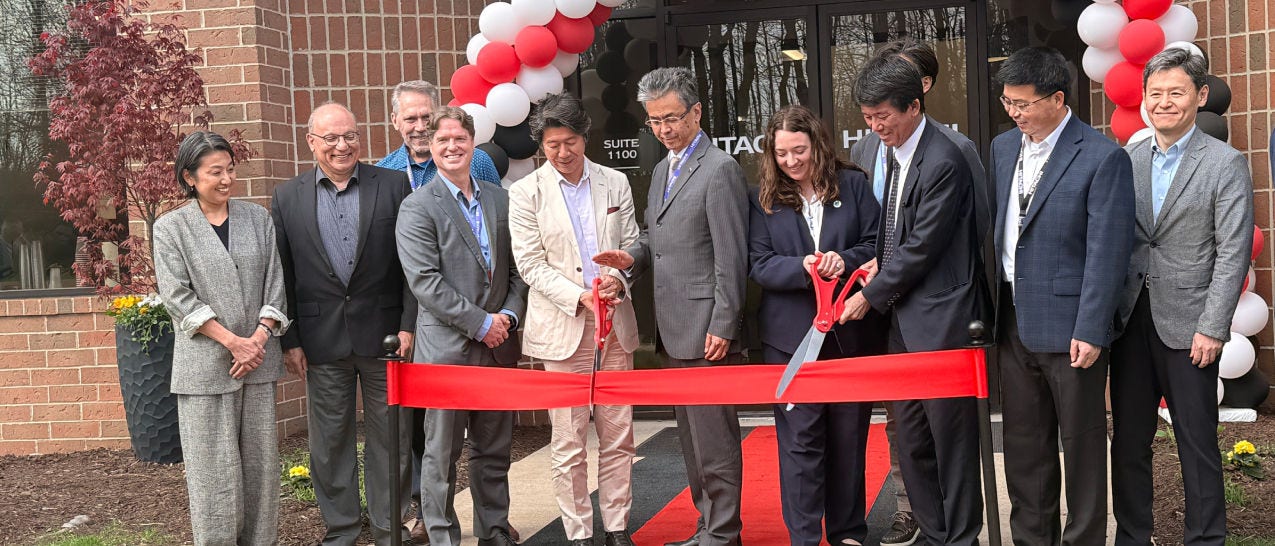
Industrial Innovation Starts on the Front Line—Hitachi’s New Industrial Innovation Lab
By Wei Yuan, Director, Industrial Innovation Lab, Hitachi America R&D
Manufacturing doesn’t have a technology problem. It has an application problem.
Across the globe, industry is investing heavily in digital systems, automation, and AI. And though the tools are more advanced than ever, their impact on factory floors remains inconsistent.
The newly opened Hitachi Industrial Innovation Lab in Novi, Michigan, changes that. This state-of-the-art facility is grounded in a simple premise: the gap between innovation and impact is created not by capability but rather by how it serves people in real work environments.
For too long, industrial innovation has been built in isolation from the realities of the factory floor. That model is no longer sufficient.
The Limits of Technology-First Thinking
As manufacturing environments grow more complex, the linear model of development, validation, and deployment is breaking down.
Many solutions are technically sound but operationally distant. They live in dashboards, pilots, and platforms—demonstrating potential but failing to translate into the daily work. The result is a disconnect between what technology can do and what it actually changes.
This disconnect is most evident in adoption.
Technologies such as IoT, robotics, AR, and physical AI are advancing rapidly. Yet manufacturers remain cautious, questioning what is real, what is practical, and what will deliver measurable outcomes.
Even when the potential seems clear, adoption is difficult. Solutions are often not designed with the workforce in mind, and organizations must navigate capability gaps, change management, cybersecurity concerns, and uncertain ROI, especially when value is not immediately visible.
As a result, adoption lags behind innovation—and impact suffers.
If workers cannot see or feel value in their daily work, adoption slows. When adoption slows, progress stalls.
Start with the Work, Not the Technology
Industrial innovation must begin with a different question: not “What can we build?” but “How is work actually done?”
This shift—from technology-first to human-centered—is not optional. It is essential.
For manufacturing to remain competitive, organizations must consider how new tools may reshape operations. That requires simultaneous focus on the actual workforce dedicated to making those operations possible.
At the Industrial Innovation Lab, the focus is on developing solutions directly with frontline workers—solutions that are usable, safe, and effective in real environments. The goal is not incremental improvement, but addressing fundamental challenges such as workforce shortages and operational complexity at their source.
When innovation is grounded in how work actually happens, it becomes easier to adopt—and far more likely to succeed.
Integration Is Where Value Is Created
Even when the need for change is clear, fragmentation remains a major barrier.
Operational technology, IT systems, and products are often developed and deployed separately. The result is complexity without cohesion.
The next phase of industrial innovation will not be defined by individual technologies, but by how effectively they are integrated.
At the Lab, this means bringing together IT, OT, and product capabilities with Hitachi’s manufacturing expertise and frontline insight to deliver unified, human-centric solutions.
Within this model, physical AI becomes practical—connecting digital intelligence directly to real-world operations. The goal is not just insight, but execution.
This creates a continuum where technology supports human decision-making and where appropriate enables automation.
It Takes an Ecosystem
Many technologies fail not because they lack potential, but because they fail to reach real-world use.
The challenge is not invention, but conversion.
Solutions must be developed in close collaboration with customers, grounded in real operational needs, and validated in practice before scaling.
No single organization can do this alone. Progress depends on an ecosystem—bringing together industry, academia, startups, and partners to co-create and refine solutions.
Located in Michigan, one of the world’s most concentrated manufacturing regions, the Industrial Innovation Lab is designed to support this approach—serving as a testbed for developing and scaling solutions with confidence.
The objective is not just faster innovation, but more effective innovation—grounded in practice and built to deliver real impact.
A Different Starting Point
The future of industrial innovation will not be defined by how advanced technology becomes, but by how effectively it is applied.
That requires a shift in mindset.
Innovation must begin where work happens. It must be shaped by the people doing that work. And it must deliver value that is not only measurable, but unmistakable.
Because in the end, industrial innovation is not determined in the lab.
It is determined on the shop floor.

Wei Yuan, PhD

Share this:


Hitachi America, Ltd.
2535 Augustine Drive, 3rd Floor
Santa Clara, CA 95054
USA