



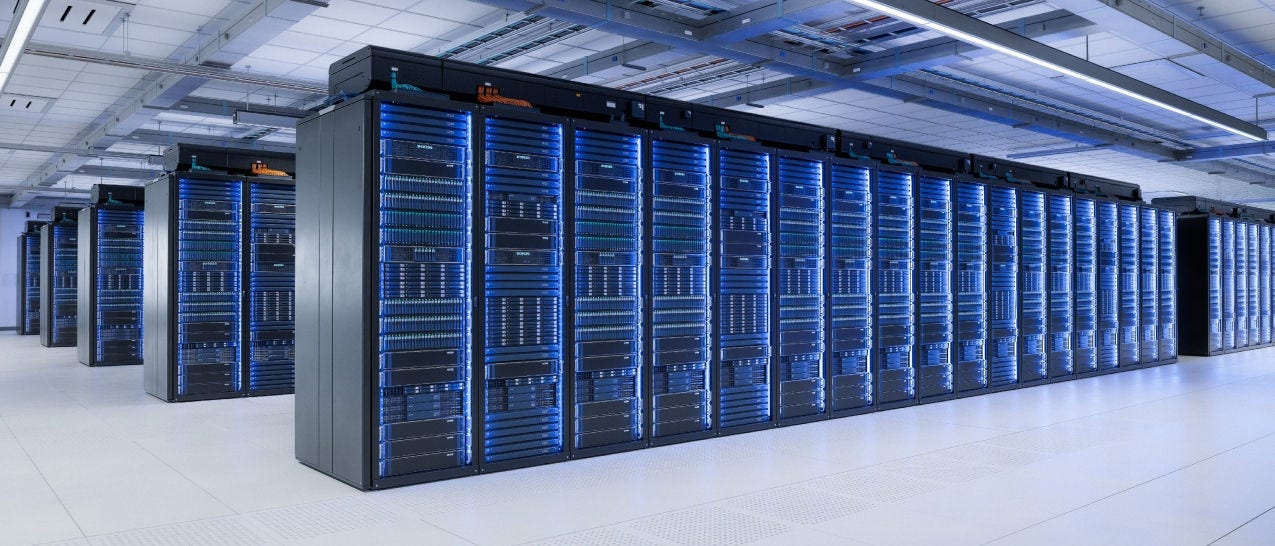
How integrated Energy Hubs can mitigate the rising challenges facing data centers
Baker Hughes and Hitachi collaborate for integrated, purpose-built onsite power solutions
By Waseem Ahmad
The global data center is at an inflection point. The rapid adoption of AI, high‑performance computing, and cloud services are driving unprecedented demand for power, yet grid availability, latent interconnection timelines, and environmental sustainability pressures are limiting growth.
From an energy standpoint, power availability is one of the primary constraints. Across key data center markets, grid capacity grows more constrained while interconnection timelines have extended significantly. Power, not land or capital, has become the gating factor for new developments and expansions.
And at a time when AI and mission‑critical workloads demand uninterrupted, high‑quality power, reliability & resilience are non-negotiable. Traditional “grid + backup” models are increasingly not sufficient for always‑on, high‑density environments.
From a sustainability perspective, consumers and regulators expect clear decarbonization pathways, hydrogen and clean fuel flexibility, cogeneration and geothermal power solutions adoption, and improved energy efficiency without compromising uptime or scalability. Traditional approaches within the data center market simply won’t work in the new era of AI. Most data center power architectures rely on multiple vendors across generation, grid infrastructure, controls, and services, which introduce integration complexities, scheduling risks, and unclear accountability.
Enter Baker Hughes and Hitachi
Recognizing these challenges, Hitachi and Baker Hughes have formed a strategic collaboration aimed at delivering integrated Energy Hub solutions that are purpose‑built for data centers.
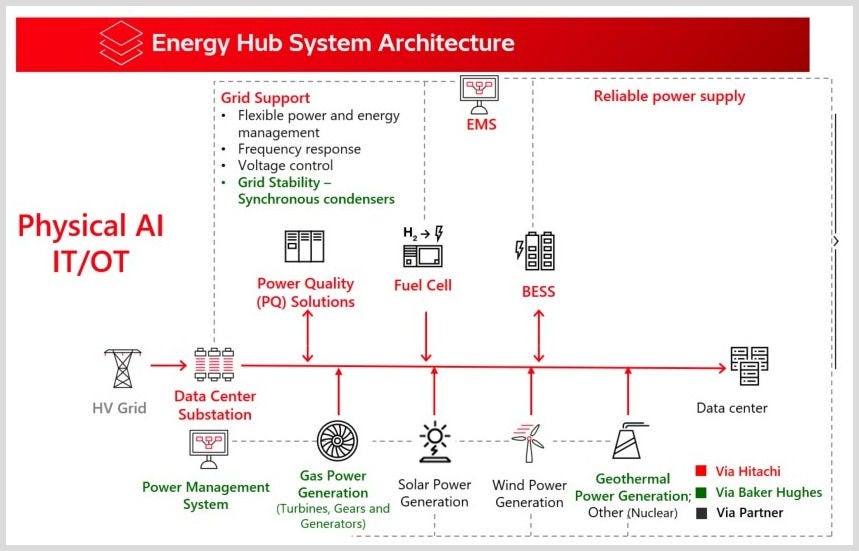
By combining Hitachi’s leadership in grid infrastructure, power systems, and digital management alongside Baker Hughes’ advanced expertise in power solutions — including hydrogen-ready gas turbines, generators, controls and automation infrastructure, synchronous condensers and power management systems — this collaboration enables data center operators to effectively address power constraints and manage peak loads. Our goal is to accelerate time-to-market with modular and scalable solutions enabling rapid and sustainable deployment aligned with growing demand.
As a result, we are shifting power from a development risk into a strategic enabler.
The Energy Hub solution
An Energy Hub is an integrated, actively managed power ecosystem that combines multiple energy sources and technologies into a single coordinated system.
Unlike traditional architectures, an Energy Hub:
- Enables bridge, prime, or supplemental onsite power
- Integrates seamlessly with grid infrastructure
- Operates flexibly across grid‑connected, islanded, and transitional states
- Uses digital intelligence to optimize performance, reliability, and cost
- Is designed for future clean fuels and evolving sustainability requirements
Together, Hitachi and Baker Hughes will combine their complimentary capabilities into a single Energy Hub scalable architecture that provides everything from high‑voltage and medium‑voltage power infrastructure to onsite power generation technologies and rotating equipment engineered for high‑reliability applications. In short, flexible, scalable, and interconnected power generation, that normally requires a variety of independent partners and components, can now be realized through this single partnership.
As the data center market continues to climb toward its $1T market value by 2035, and construction continues to grow beyond the 4,000+ existing and in-production data centers, power availability and sustainability will only grow more critical.
Baker Hughes and Hitachi’s common goals is to provide an architecture that supports higher efficiency today while enabling a transition toward lower‑carbon fuels, renewable integration, and evolving regulatory requirements. And by aligning power generation, grid infrastructure, and digital control systems under a unified solution framework, customers benefit from simplified execution, clearer accountability, and reduced lifecycle risk.
Waseem Ahmed is Vice President, Data Center Business, Hitachi Americas.
Share this:


Hitachi America, Ltd.
2535 Augustine Drive, 3rd Floor
Santa Clara, CA 95054
USA