




Scaling Fleet Electrification: The Truck Was Never the Hard Part
By Prashanth Bhushan, Thierry Lassus & Daniel Simounet
Commercial fleet electrification has entered a new phase of maturity. Across logistics, public transportation, municipal services, and last-mile delivery, the question is no longer whether electric vehicles (EV) are available or capable; it’s whether these elements can be orchestrated into a single integrated system that protects uptime, cost per mile, and service continuity at scale.
To be sure, none of the barriers to scale is a vehicle problem, and none can be solved by any single company acting alone. Scaling electrification requires genuine teamwork across the ecosystem. Organizations that internalize this philosophy will define the next generation of commercial mobility.
The Constraints that Actually Bind
Three of the leading barriers to scale come down to a general misunderstanding of what’s needed from an investment standpoint, the need for greater software interoperability, and a lack of EV maintenance expertise.
- Depot power and interconnection. Many operators assume the primary investments are the vehicle and the charger, only to find that existing depot infrastructure cannot support the required power density. Utility upgrade timelines frequently extend beyond fleet deployment schedules, and in mixed-fleet environments — vans, yard tractors, school buses, heavy-duty vocational vehicles — each operating cycle adds a distinct charging profile that compounds the problem into delayed deployments and stranded capital.
- Software fragmentation. Routing, charging, energy procurement, maintenance, and customer operations are still managed across disconnected platforms. That model is workable on diesel; in an electrified operation it is not. Routing must align dynamically with charging availability, energy pricing, depot capacity, and telemetry, making interoperability an operational requirement rather than a technical enhancement.
- Service and support ecosystem. Long-term viability depends on diagnostics, technician enablement, parts availability, and responsive field support. Electrified operations demand software-enabled diagnostics and advanced electrical competencies that differ markedly from mechanical service models, and upskilling, certification, and qualified labor have not yet scaled at the pace the transition requires. Where these capabilities remain underdeveloped, procurement momentum slows.
From Procurement to Operating Model
That said, operators who have moved beyond pilots are redesigning their operating models around the metrics that define their business: uptime, productivity, service levels, and cost per mile. Emissions reduction remains a strategic commitment, but it is not the operational lens through which fleet decisions are made. The successful operators have stopped asking whether an EV can be deployed and have begun asking how the entire operation must be restructured so that electrification preserves or improves these core metrics.
This is driving a structural shift toward asset-light business models. Charging-as-a-Service, Battery-as-a-Service, Depot-as-a-Service, and Fleet-as-a-Service are gaining traction because they address the constraints operators actually face: limited capital, competing investment priorities, and execution risk. The question is no longer whether the investment can be financed but whether a partner can deliver the entire system at a defined service level. Competitive advantage is moving away from individual product features and toward end-to-end execution capability.
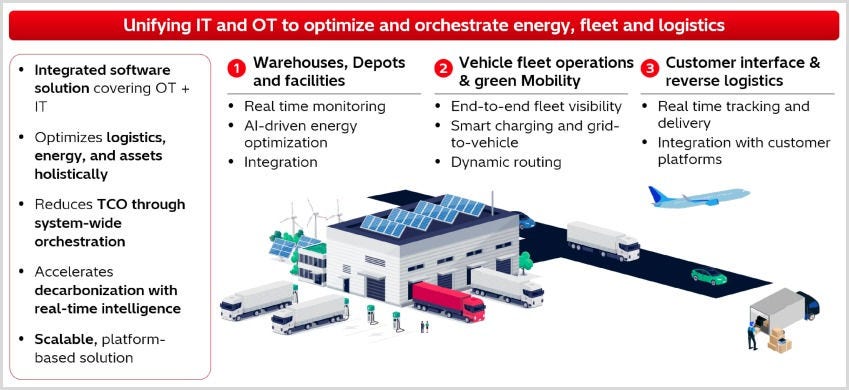
Software and artificial intelligence sit at the center of this redesign. In a diesel operation, software is a support function. In an electrified operation, the integration of advanced software and AI determines which vehicles are deployed, when and where they charge, the routes they run, the cost at which charging occurs, and how downtime is minimized.
In addition, the convergence of operational technology (OT) and information technology (IT) is now the defining capability, and the maturity of the software stack, not the maturity of the vehicle, increasingly determines fleet performance.
Execution capability follows the same logic. Operators who are scaling the fastest have either built turnkey capabilities in-house or selected partners who deliver vehicle, charger, software, service, and training as a single integrated package, supported by modular and prefabricated infrastructure that compresses deployment timelines and reduces field-labor dependency.
Energy Architecture Beyond the Grid
Where grid capacity is constrained, operators are increasingly evaluating alternative energy architectures. Behind-the-meter generation, battery energy storage systems, microgrid configurations, and battery-integrated charging are extending an infrastructure’s reach into locations that interconnection delays would otherwise block. Battery-integrated chargers, in particular, enable high-power charging where grid upgrades would be cost- or timeline-prohibitive.
Vehicle-to-grid integration remains a longer-horizon opportunity. The technology is approaching readiness, but utility coordination, regulatory alignment, and fleet operational priorities constrain near-term adoption. Demand response programs, or strategic charging schedules, offer a more accessible first step, and vehicle-to-grid is likely to mature first in vehicle operating cycles that have high idle time, such as school buses, before extending into commercial logistics.
Across all of these, the complexity of the ecosystem exceeds the capability of any single participant. Vehicle manufacturers, charging providers, energy companies, software platforms, financiers, utilities, and operators would be wise to align around shared standards and execution models. The organizations that convene this dialogue and translate it into integrated delivery will hold a structural position in the market.
The Hitachi Advantage
Scaling commercial fleet electrification requires orchestrating an integrated ecosystem across energy supply, charging infrastructure, vehicle systems, software intelligence, financing, and lifecycle services. No single company can handle this transition alone. Hitachi’s role is to bring the whole ecosystem together by connecting vehicle OEMs, utilities, technology vendors, and charging providers so everything works as one.
Hitachi’s experience across more than a century of rail electrification translates directly to electric road mobility, as well as to marine. The work integrates seamlessly with the company’s decades of R&D and deployment of solutions across energy, digital engineering, AI, and manufacturing. We also know that customer needs vary wildly across a fragmented market. A retailer managing last-mile delivery vans has completely different requirements than a transit operator running city buses. Hitachi handles these diverse needs through a flexible grid-to-plug operating model Hitachi brings to fleet operators, unifying four traditionally siloed layers:
- Energy and charging. Hitachi addresses the most significant barrier to electrification — access to reliable, high-density power across depot and route environments — through grid interconnection support, behind-the-meter infrastructure, battery energy storage systems, microgrid architectures, and battery-integrated charging that decouples deployment from utility upgrade constraints.
- Vehicle and powertrain. Decades of powertrain, traction, and energy-management engineering, developed through global leadership in rail electrification, transfer across modalities and operating cycles as rail, road, and adjacent segments converge.
- Digital intelligence. Hitachi delivers the IT-OT convergence that unifies fleet management, charging orchestration, energy optimization, and predictive maintenance into a single control layer, the determinant of operating performance and total cost of ownership as fleets scale.
- Lifecycle service. Beyond deployment, Hitachi supports technician training, diagnostic tooling, parts availability, battery state-of-health monitoring, and second-life strategy, closing the support-ecosystem gap that today constrains procurement across public-sector and mid-market fleets.
By integrating these layers into a single model, Hitachi enables operators to accelerate time-to-deployment, protect uptime and cost economics, reduce execution risk, and scale electrification with confidence.
From Electrified Vehicles to Intelligent Mobility Ecosystems
The constraints the industry now faces — depot power, interconnection timelines, software interoperability, workforce readiness, service maturity, and capital allocation — are not temporary. They are structural features of an industry moving from a hardware-led model to an ecosystem-led one. Success will not be determined by isolated investments in vehicles, chargers, or software, but by the ability to orchestrate an integrated grid-to-plug ecosystem built for speed, resilience, and durable economics.
Increasingly, that orchestration will shift from manual coordination to intelligence-led optimization, with software and AI embedded across the ecosystem to balance energy flows, predict demand, automate processes, and protect uptime. Hitachi is committed to this direction and to helping operators achieve the kind of growth and scale they aspire to – today. “As our customers operate globally, Hitachi can support them with our global presence and years of experiences in more than 100 countries around the world,” said Thierry Lassus, Head of Mobility Segment at Hitachi. “Regardless of where your fleet runs on the road, Hitachi is nearby to support you.’’
Prashanth Bhushan is VP of Connective Industry Business, Hitachi Americas.
Thierry Lassus is Head of Mobility Segment, Hitachi, Ltd.
Daniel Simounet is VP of Transportation Industry - North America, Hitachi Energy.
Share this:


Hitachi America, Ltd.
2535 Augustine Drive, 3rd Floor
Santa Clara, CA 95054
USA