



Solving the AI Data Center Problems of the Future Today
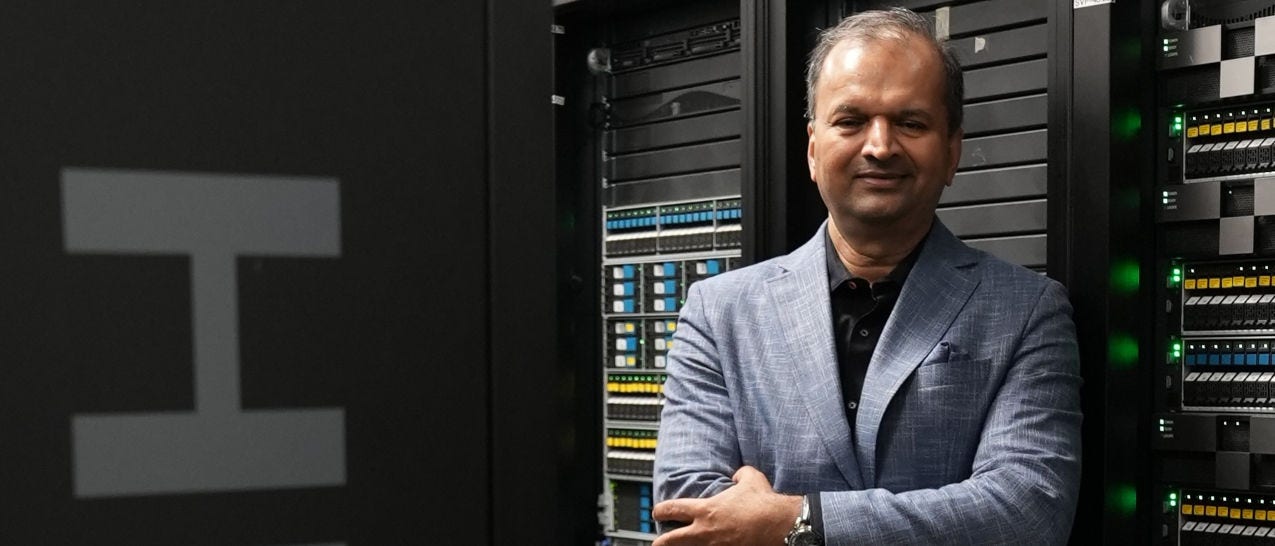
By KJ Joshi, Chief Business Officer and Head of Data Center Business, Hitachi Ltd.
The rapidly expanding world of AI data centers is leading to more than just surging power demand; it’s driving operators to rethink everything from advanced cooling solutions to sophisticated, reliable energy sources.
Bottlenecks around these issues and more, such as constrained electrical supply chains, interconnection challenges, and aging labor, are intensifying as energy climbs. This year alone, power demand for U.S. data centers is expected to rise to 75.8 GW, according to a recent report from 451 Research, part of S&P Global. The firm estimates that to balloon to 134.4 GW by 2030.
It’s becoming clear that a new approach to the construction and ongoing management of the AI data center requires much more than siloed fixes to isolated problems. What’s needed is a system-level orchestration across energy supply, electrical infrastructure, cooling, digital intelligence, and operational resilience.
Critical Constraints
Consider the rising AI training clusters and hyperscale campuses. These facilities, which are increasingly being designed for hundreds of megawatts, now require continuous, high-quality power at levels far beyond traditional enterprise workloads. However, grid congestion and interconnection queues remain major hurdles, creating a growing mismatch between 12–24 month deployment timelines and utility lead times that can extend from 3–7 years.
As compute densities increase, thermal limits are emerging as a parallel infrastructure constraint. Traditional air-cooling systems are no longer sufficient to support next-generation AI workloads, forcing a transition to liquid cooling and more advanced thermal management architectures.
This shift introduces new dependencies on water availability, site conditions, and infrastructure integration, making thermal strategy a core consideration in data center design rather than a downstream engineering decision.
Site selection is also undergoing a structural shift, historically driven by connectivity and land availability, it is now increasingly anchored on access to power and the ability to secure grid connections within reasonable timelines.
Compounding all of the above is intensifying operational and supply chain challenges. Supply chains for critical components such as transformers and switchgears are under significant pressure, construction timelines are expanding, and there is a shortage of skilled labor, specifically electricians and commissioning engineers. As a result, there is a mismatch between demand and delivery capability.
Where it Begins
For many of these challenges, it begins with site selection. That’s why, today more developers are prioritizing locations based on energy availability, grid readiness, and the long-term scalability of power supply.
In addition to locating in power-rich regions such as Texas and Virginia, new energy architectures are emerging that combine grid supply with on-site generation. Through solutions like advanced battery energy storage systems (BESS), hybrid and more resilient power ecosystems can be created.
All of this reflects a broader move toward optimizing the power mix to balance reliability, sustainability, and speed of deployment. BESS and microgrid configurations are playing a pivotal role in this transition, enabling operators to manage peak loads, mitigate grid congestion, and improve resilience in high-density AI environments. As AI workloads introduce greater variability and intensity in power demand, the ability to orchestrate multiple energy sources is becoming a strategic advantage.
To that end, Hitachi recently announced a strategic collaboration with X LABS LLC to develop dedicated “energy parks” designed as behind-the-meter power supply hubs with co-located, GW-scale infrastructure for AI data center off-takers in North America. These on-site power supply hubs are built to serve as a primary power source while coordinating with the regional power grid, providing reliable and controllable large-scale power procurement without having to wait for grid reinforcement.
Another area of rapid change is the move toward integrated grid-to-rack architectures, where power systems are designed as an end-to-end electrical chain spanning the utility grid to the rack inside the data center. Scaling AI infrastructure now requires more power procurement or faster construction in isolation. It requires system-level orchestration across energy supply, electrical infrastructure, cooling, digital intelligence, and operational resilience.
Partnering with Integrated Expertise from Energy to AI
Hitachi’s differentiated advantage lies in its ability to unify these traditionally siloed layers into a single operating model. Through the One Hitachi approach, customers gain access to integrated capabilities spanning grid expertise, power systems, behind-the-meter energy architecture, battery storage, digital twins, operational software, data management, and modular infrastructure delivery.
- At the energy layer, Hitachi helps customers address the most immediate constraint to AI scale: access to reliable, high-density power. This includes grid modernization, substations, behind-the-meter energy systems, microgrids, BESS, and diversified generation pathways that improve resilience while accelerating time to energized capacity.
- At the infrastructure layer, Hitachi enables a seamless electrical chain from utility interconnection through on-site power distribution and into rack-level delivery. This grid-to-rack approach reduces fragmentation across design, deployment, and operations while improving reliability for high-density AI environments.
- At the digital layer, simulation, digital twins, and AI-driven operational software help customers optimize load balancing, improve infrastructure visibility, predict failures, and reduce risk before deployment. These capabilities become increasingly critical as campuses move toward gigawatt-scale power density.
- At the execution layer, Hitachi’s modular and prefabricated deployment models help compress construction timelines, improve quality, and reduce reliance on constrained field labor. This enables customers to move from power secured to workload-ready capacity with greater speed and confidence.
By integrating energy, infrastructure, digital intelligence, and modular execution into a unified model, One Hitachi helps customers accelerate time-to-capacity, reduce deployment risk, strengthen energy resilience, and scale AI workloads with greater confidence.
AI infrastructure is rapidly emerging as one of the most important enablers of future economic growth, transforming data centers from isolated assets into the backbone of a new energy-digital economy. Hitachi’s ability to align power systems, physical infrastructure, digital intelligence, and lifecycle operations into a cohesive operating model will determine who can scale first, reduce risk, and lead in the AI era.
For more information about Hitachi's work in data center energy solutions visit: Data Center Energy Solutions | Hitachi Energy
Share this:


Hitachi America, Ltd.
2535 Augustine Drive, 3rd Floor
Santa Clara, CA 95054
USA