



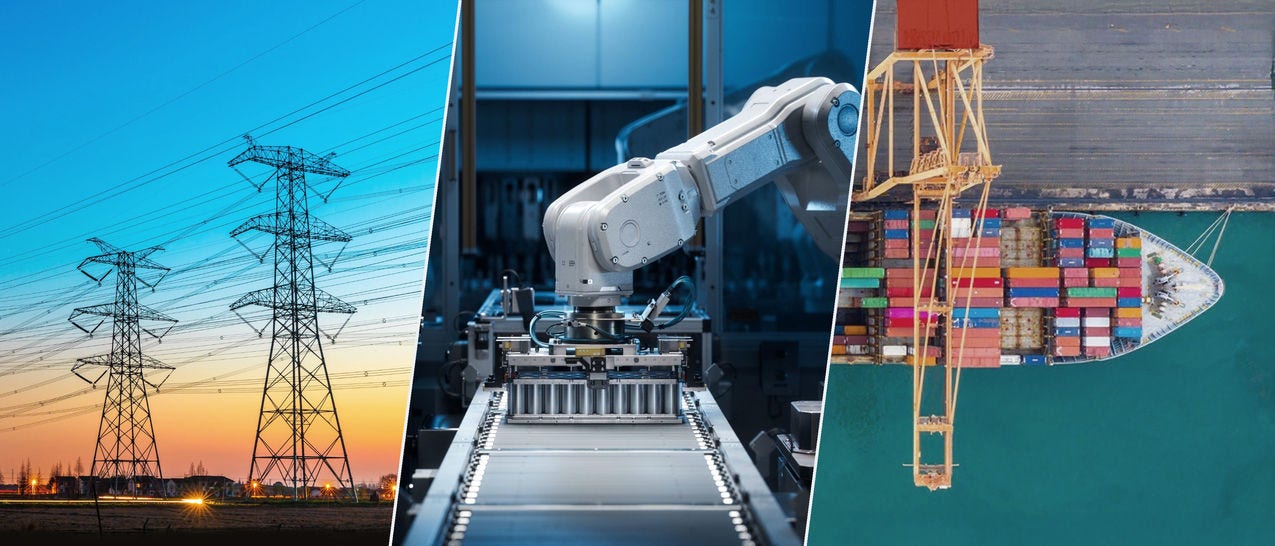
Three Innovations Shaping the Future of Industry
Hitachi earns three 2026 R&D 100 Awards for advances in energy, smart manufacturing, and supply chain intelligence
From an evolving power grid to smarter factories and increasingly complex global supply chains, businesses face a common challenge: making faster, better decisions in environments where complexity continues to grow.
Three Hitachi technologies tackling these challenges have been recognized with 2026 R&D 100 Awards, spanning three areas critical to the future of industry: the energy transition, smart manufacturing, and intelligent supply chains.
Presented annually by R&D World, the R&D 100 Awards recognize 100 of the year’s most significant new technologies. Established in 1963, the awards are among the longest-running recognitions of innovation in science and engineering.
This year’s Hitachi winners demonstrate how advances in AI and precision engineering can translate into practical solutions for some of industry’s most pressing challenges.
Accelerating Grid Planning for the Energy Transition
The power grid is under immense pressure to accommodate new sources of generation and demand. Utilities and system operators must connect renewable energy sources, data centers, and other large loads while maintaining the reliability of critical infrastructure. Evaluating these connections requires complex transmission studies that can become a significant bottleneck to grid expansion.
To help address this challenge, Hitachi America R&D and Hitachi Energy collaborated to develop an AI-based grid planning solution that combines physics-based power system modeling with advanced computational techniques.
Recognized with an R&D 100 Award in the IT/Electrical category, the solution accelerates complex grid simulations without sacrificing the accuracy required for critical planning decisions, enabling planners to evaluate more scenarios in less time. The technology can support grid expansion, accommodate a rapidly changing mix of generation and load, and help utilities make infrastructure investments with greater confidence.
Bringing Precision Measurement to Smart Manufacturing
Precision manufacturing has long faced a critical bottleneck: the inability to reliably measure complex internal geometries in manufactured components that directly determine product performance. Manufacturers rely on manual, sampling-based inspection using specialized probes, leading to long setup times, operator dependency, and limited quality assurance.
A non-contact laser dimensional scanning probe, developed by Hitachi, Ltd. and Hitachi High-Tech Corporation in collaboration with Nagano Automation Co., Ltd., eliminates this limitation.
Recipient of a R&D 100 Award in the Analytical/Test Category, the system enables simultaneous measurement of sidewall profiles and depths in hard-to-access internal geometries using a single non-contact probe under actual manufacturing conditions.
By integrating FMCW (Frequency Modulated Continuous Wave) laser ranging with proprietary polarization-based beam control, the technology captures both sidewall and depth profiles across a wide diameter range (6–100 mm) with ±5 μm accuracy. Unlike conventional systems, it maintains accuracy under fluctuating factory temperatures (10–35 °C) and operates at high speed (10,000 points/s), enabling true full in-line inspection without probe exchange or manual calibration.
This innovation transforms internal geometry measurement from a manufacturing bottleneck into a scalable digital process.
The technology enhances productivity, traceability, and reliability while accelerating the transition to next-generation smart manufacturing driven by data and autonomous decision-making.
Advancing Intelligence Across Global Supply Chains
Companies may have good visibility into their direct suppliers, yet some of their greatest vulnerabilities lie several tiers deeper. A disruption involving an unknown sub-supplier, geographic concentration, or critical raw material can ripple across an entire supply chain.
Building that deeper visibility has traditionally required lengthy supplier surveys. And even then, important gaps can remain.
Earning a R&D 100 Award in the Process/Prototyping category, Hitachi America R&D’s Supply Chain Intelligence Platform uses Graph AI to reconstruct the multi-tier supplier network behind a manufacturer’s product, extending all the way to raw-material origins without requiring time-consuming supplier surveys. Starting with data that manufacturers already have, such as bills of material, the platform combines information from global trade, customs, and compliance records to uncover supplier relationships that would otherwise remain hidden.
The platform provides confidence-scored intelligence about deep-tier relationships, helping companies uncover hidden dependencies and make better-informed decisions about supply chain risk, resilience, compliance, and business continuity.
For businesses operating amid geopolitical uncertainty and increasingly interconnected supplier ecosystems, that visibility can provide something increasingly valuable: the ability to identify vulnerabilities before they become disruptions.
Turning Innovation into Business and Social Value
Although these three technologies address very different challenges, they share a common purpose: helping organizations understand complex systems and make better decisions.
Hitachi’s grid planning technology helps utilities navigate a rapidly changing energy system. The non-contact laser dimensional scanning probe turns precision inspection into a scalable digital process for smarter manufacturing. And the Supply Chain Intelligence Platform reveals relationships and risks that can otherwise remain hidden deep within global supply networks.
Together, the three R&D 100 Awards reflect Hitachi’s approach to innovation—combining deep domain expertise and an understanding of the physical world with AI, advanced computing, and digital technologies to solve real-world problems.
Through innovations like these, Hitachi will continue to help customers address business and societal challenges while contributing to a more sustainable and resilient society.
Share this:


Hitachi America, Ltd.
2535 Augustine Drive, 3rd Floor
Santa Clara, CA 95054
USA