



Efforts in the Research Accelerator Business
Hitachi's History of the Research Accelerator Business
Accelerators have developed into powerful research tools in advanced science, and have been widely used in fields such as elementary particles, space, materials, and life sciences, as well as in a wide range of industrial applications. In particular, research accelerators are becoming increasingly diverse. Examples include high-energy accelerators for energy fronts that explore the origins of elementary particles, the universe, and matter itself; high-intensity beam accelerators that generate and use a large number of secondary particles; and accelerators for research promoting the use of radiation. Since the 1970s, we have actively participated in research institute planning, and continued to work on the construction of major research accelerators in Japan.
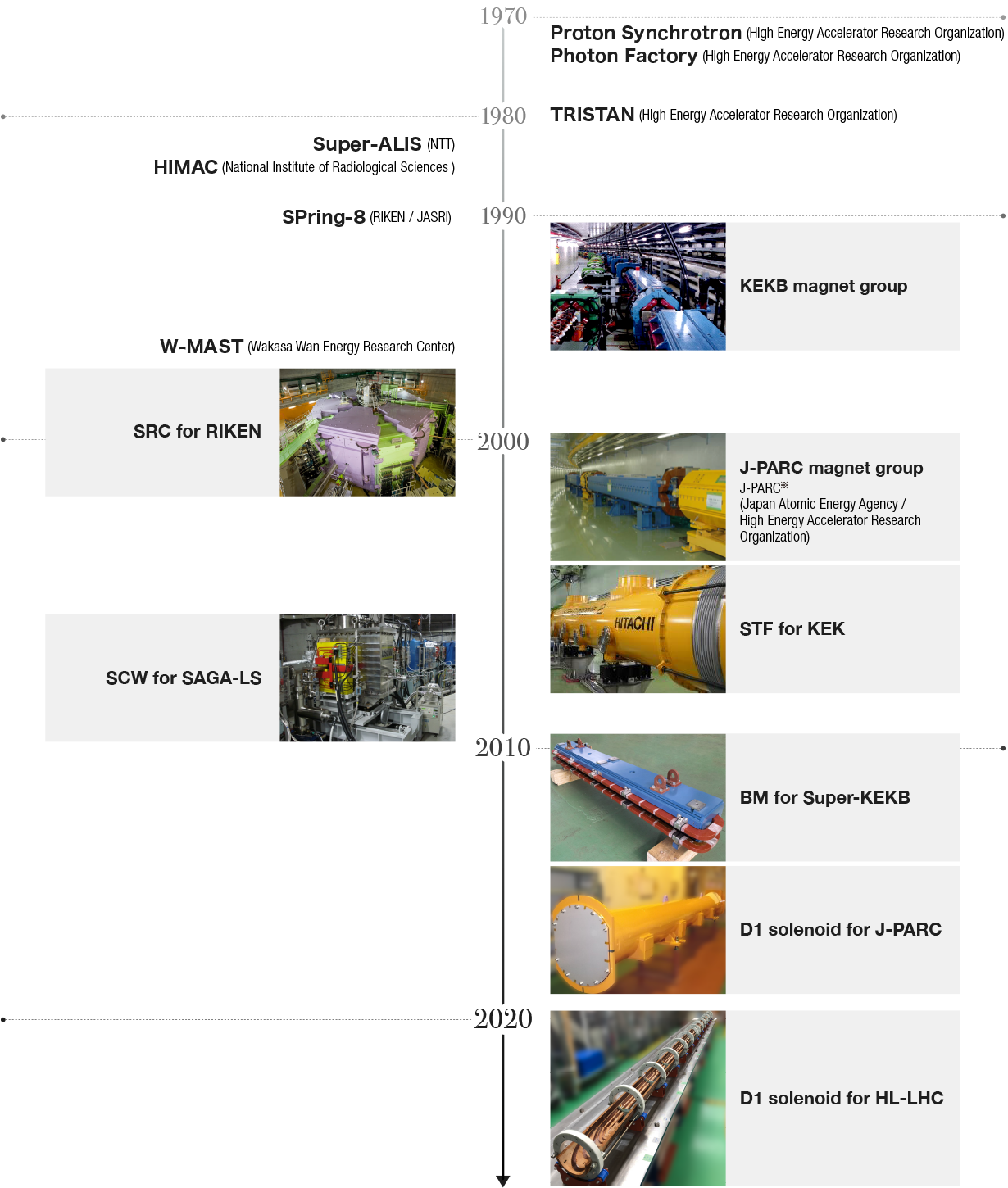
- J-PARC is a registered trademark of Japan Atomic Energy Agency and High Energy Accelerator Research Organization.
About Research Accelerator Business Product
Superconducting Magnet for High-Energy Accelerator HL-LHC-D1
At the European Organization for Nuclear Research's (CERN) Large Hadron Collider (LHC), the construction of a High-Luminosity Large Hadron Collider (HL-LHC) is currently underway, with the aim of improving the performance of the LHC to further explore new physics. As part of the international cooperation with CERN, Hitachi has received an order for the superconducting magnet (D1), and we are working on its manufacture.
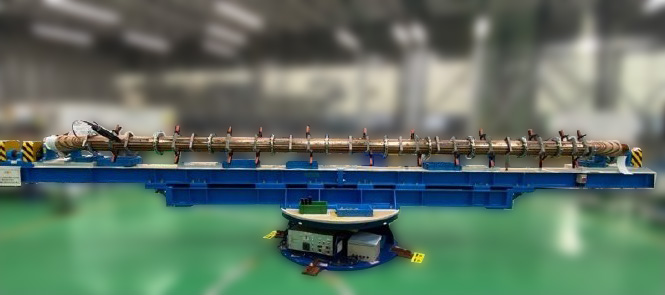 Winding of superconducting coil
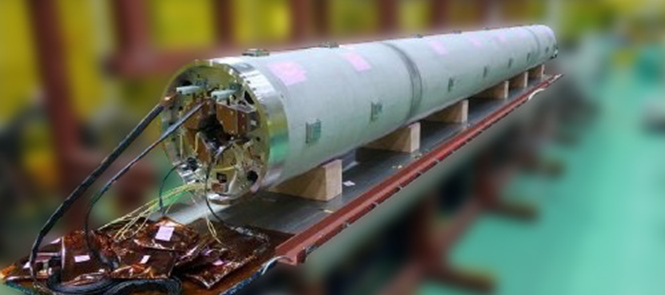 Welding the shell to the superconducting magnet
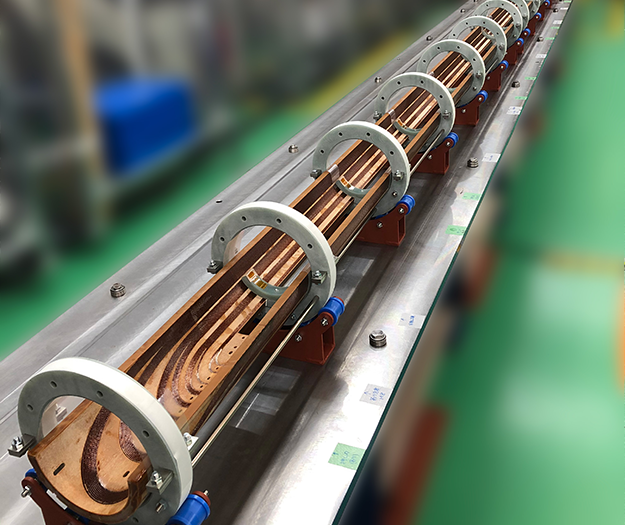 Inner view of D1 magnet
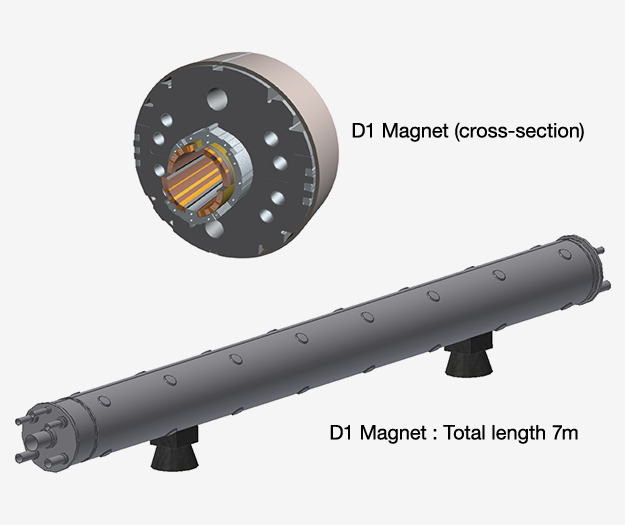 Cross section and the full length of D1 magnet
Provided by High Energy Accelerator Research Organization
MgB2 Superconducting Solenoid Magnet for Klystron
The use of a klystron is being considered for the CERN 's Compact Linear Collider (CLIC) project, a candidate future accelerator project. Together with the High Energy Accelerator Research Organization (KEK), Hitachi has developed a superconducting solenoid magnet for the prototype klystron. By using MgB2 (magnesium diboride) as the material for the coil conductor, this magnet has an operating temperature range (25Kelvin) where a single-stage Gifford-McMahon Cryocooler r can be used, and will contribute to energy savings in comparison to magnets made from copper or NbTi (niobium-titanium alloy). This magnet also won the 2020 R&D World R&D Awards 100 and the Cryogenics and Superconductivity Society of Japan's 2021 Science and Technology Impact Award.
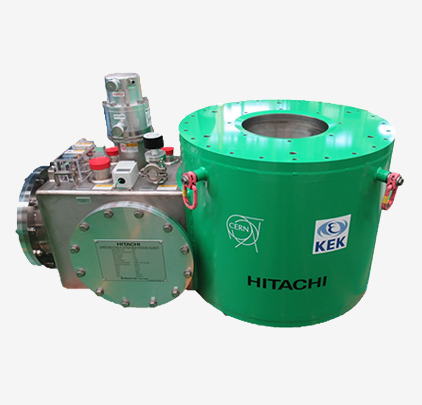 Photo courtesy of KEK and CERN Magnet
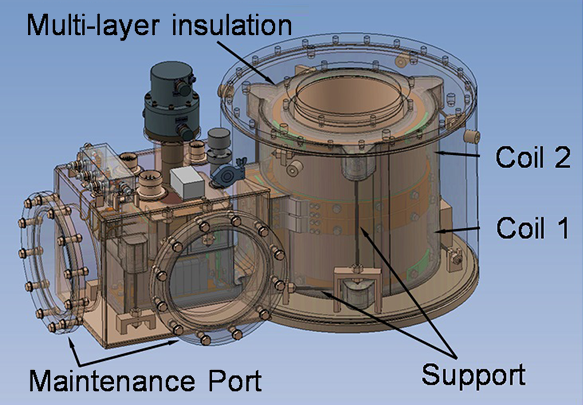 Overview of magnet
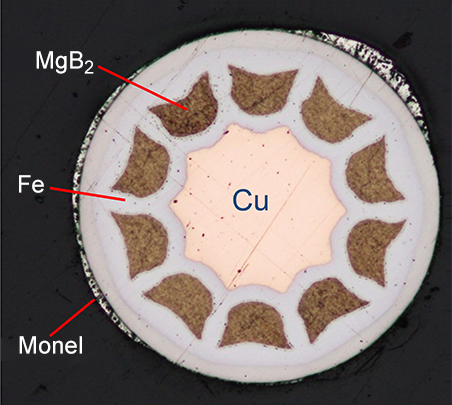 MgB2 conductor cross-section
Superconductive Wiggler for SAGA Light Source
At SAGA Light Source (SAGA-LS), a synchrotron light facility, Hitachi installed two superconducting wigglers (SCW) with a magnetic field of 4T (Tesla) to meet the need for higher energy synchrotron light. We collaborated with SAGA-LS in designing, manufacturing, and installing the SCWs on site, and carry out regular maintenance contributing to their stable operation.
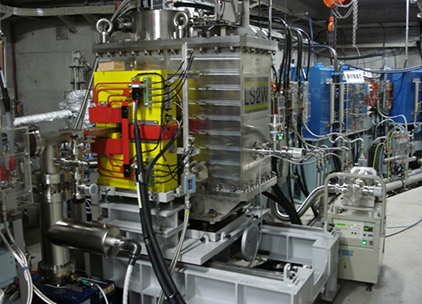 Superconducting Wiggler at SAGA-LS
Photo courtesy of SAGA-LS
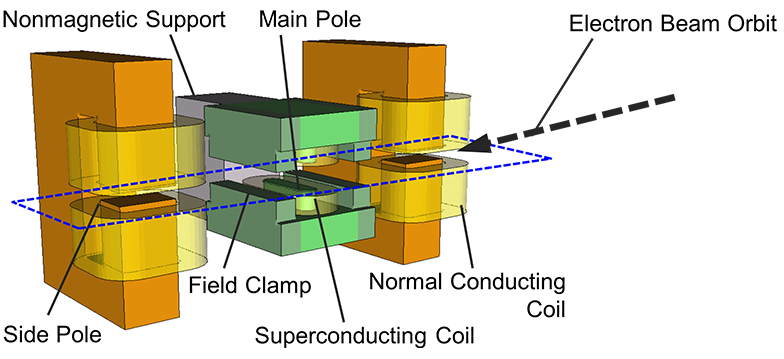
Superconducting Ring Cyclotron (SRC) Sector Electromagnet
RIKEN's RI Beam Factory (RIBF), a heavy ion accelerator facility, developed the world's first superconducting ring cyclotron (SRC), which accelerates heavy ions up to uranium ions as the facility's final stage accelerator. Hitachi was in charge of manufacturing all six sector electromagnets—the most critical component in the SRC—based on manufacturing technology for large superconducting magnets that we have cultivated over many years.
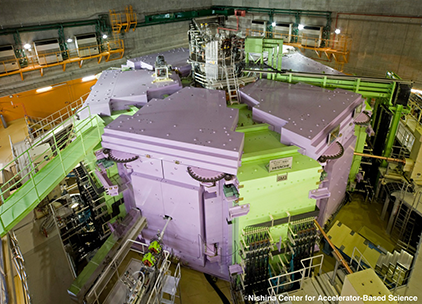 SRC (Superconducting Ring Cyclotron)
Photo courtesy of RIKEN
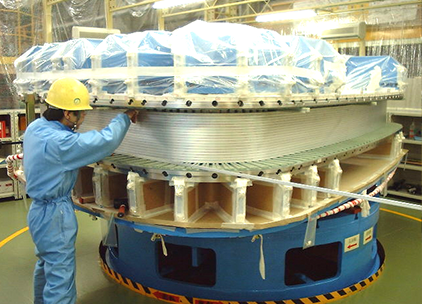 Superconducting main coil
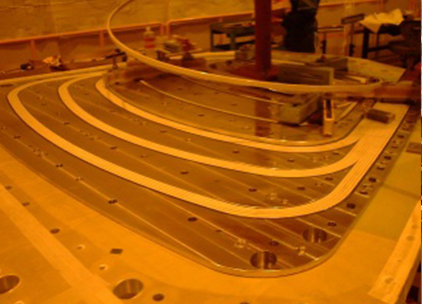 Superconducting trim coil
Superconducting Solenoid Magnet for Muon Transport for the Japan Proton Accelerator Research Complex (J-PARC)
A muon beamline (D-line) constructed at the Japan Proton Accelerator Research Complex (J-PARC)— Muon science facility of the High Energy Accelerator Research Organization (KEK)—had been in operation until superconducting solenoid magnets for muon transport installed in the D-line were damaged by the 2011 Tohoku earthquake, making it necessary to manufacture replacement superconducting solenoid magnets. Hitachi designed, manufactured, and delivered one solenoid magnet (D1) with a total length of 6 m on the upstream side and two solenoids (D2 and D3) with a total length of 1.5 m after branching.
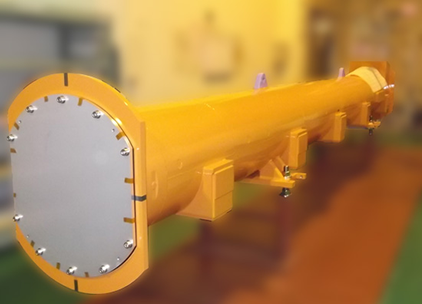 D1 solenoid
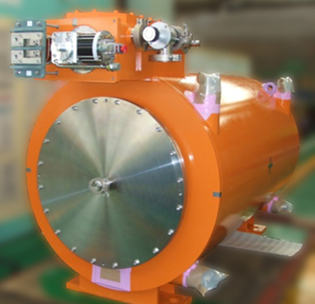 D2 solenoid
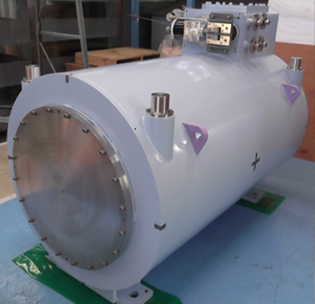 D3 solenoid
(Photo courtesy of KEK)
Electromagnets for Japan Proton Accelerator Research Complex (J-PARC)
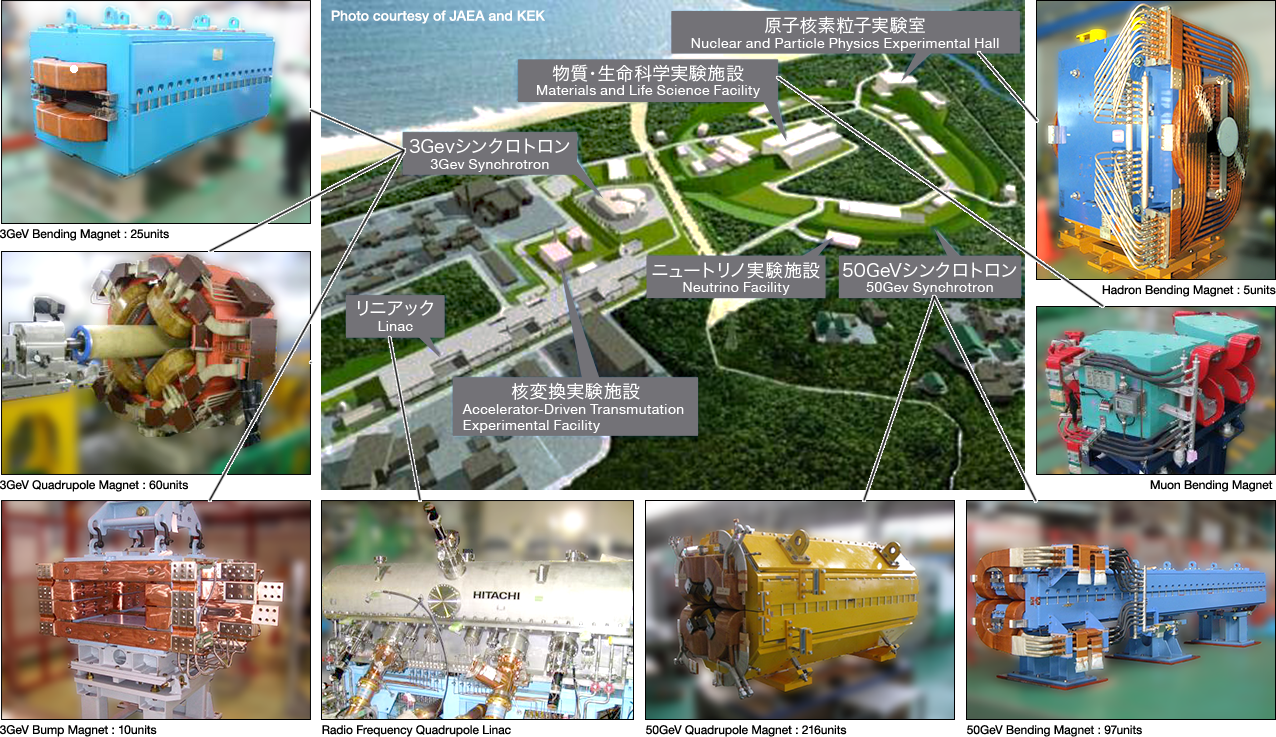
Hitachi has also delivered a group of large, high-precision electromagnets for experimental equipment at the Japan Proton Accelerator Research Complex (J-PARC), contributing to leading scientific and research activities in the 21st century (in areas including materials science, life science, nuclear and elementary particle research, and nuclear transmutation technology research).
Related Links
Conference Presentation
10th ACASC-2nd Asian ICMC-CSSJ
MgB2 solenoid magnet for klystron application without radiation shield
Koga Tomoyuki, Watanabe Hiroyuki, Tanaka Hideki, Wakuda Tsuyoshi, Yamamoto Akira*1
IEEE TRANSACTIONS ON APPLIED SUPERCONDUCTIVITY
Development of Prototype MgB2 Superconducting Solenoid Magnet for High-Efficiency Klystron Applications
Hiroyuki Watanabe , Tomoyuki Koga, Hideki Tanaka , Tsuyoshi Wakuda, Akira Yamamoto*1, Shinichiro Michizono*2, Igor Syratchev*3, Gerard Mcmonagle*3, Nuria Catalan Lasheras*3, Sergio Calatroni*3
Particle Accelerator Society of Japan
DESIGN AND MANUFACTURE OF SUPERCONDUCTING TRANSPORT SOLENOID FOR D-LINE AT J-PARC MUON SCIENCE FACILITY
Yasuyuki Tanaka, Tomoyuki Semba, Shotaro Nakajima, Yoshiaki Hagiwara, Shuichi Kido, Kenichi Sasaki*4, Koichiro Shimomura*4, Naritoshi Kawamura*4, Patrick Strasser*4, Yasuhiro Maki*4
- KEK / CERN
- KEK
- CERN
- High Energy Accelerator Research Organization
Hitachi Review
Hitachi Review Vol89 No.02 192-193
Takashi Watanabe
Takabumi Yoshinari
Yutaka Chida
Shoichiro Koseki, Dr. Eng.
Mitsushi Abe
Hitachi Review Vol.90 No.02 170-171
Shuichi Kido, Dr. Eng.
Tomoyuki Semba, Dr. Eng.
Takashi Masumoto
Yoshiaki Hagiwara
Tsunehiko Yamauchi


