



25th March 2026
Building High Performing Public Transportation
Public transport networks around the world are transitioning from early electrification pilots to full-scale deployment. In collaboration with leading operators, our webinar on Electrification at Scale explored how we can build systems that are cleaner, more reliable, and ready to operate at scale.
As policies evolve and the industry strives for decarbonization, operators are under increasing pressure to improve infrastructure and meet net zero targets while maintaining reliable, high-quality services. This transition requires new approaches, stronger collaboration, and smarter technology.
Key Takeaways
The discussion highlighted a clear shift in focus across the industry. Early electrification pilots focused on proving technology, while today the priority is making electrification work reliably at scale in everyday operations.
Operators are navigating challenges such as rising costs, infrastructure constraints, and the seamless integration of new technologies into existing networks. At the same time, advancements in digital innovation, energy systems and grid integration, and battery performance are creating new opportunities to improve efficiency and reliability.
Key Themes:
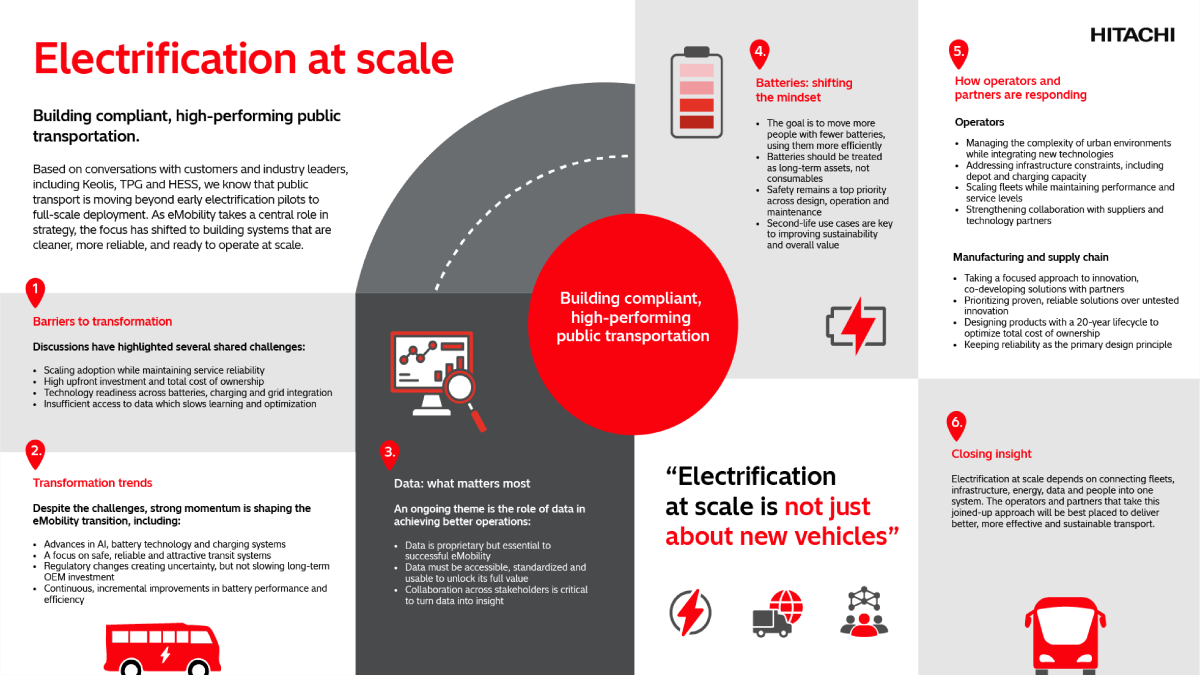
Overcoming Barriers to Scaling
High upfront costs, grid constraints, and infrastructure challenges continue to slow progress. Addressing these challenges will not only enable wider deployment but also ensure transport systems can operate reliably at scale without compromising service.
Data as a Strategic Asset
Access to high quality, standardized, and real-time data allows operators to make informed decisions, improve predictability, and proactively respond to issues, in turn minimizing downtime and improving network reliability.
Collaboration Drives Progress
Electrification at scale requires close collaboration between operators, technology, and infrastructure providers. By working together, we can integrate systems more effectively, reduce risk, and accelerate the transition to a fully electrified transport system.
Technology is Accelerating the Transition
Advancements in AI, battery technology, and charging systems are making electrification increasingly achievable. These innovations are reducing operational risk, improving system performance, and enabling secure and seamless service.
Optimizing Battery Strategy is Key to Long-Term Success
The objective is to move more people with fewer batteries. By treating batteries as long-term assets and embedding circular economy principles central, we can strengthen sustainability while increasing overall value.
How Key Stakeholders are Responding
Operators
Overcoming infrastructure constraints, particularly depot and charging capacity
Expanding fleets while maintaining performance, reliability, and service levels
Building stronger partnerships with suppliers and technology providers to drive innovation
Manufacturing and supply chain
Strengthen collaboration with partners to co-create innovative solutions
Prioritize proven, reliable solutions over untested innovation
Designing products for a 20-year lifecycle to optimize total cost of ownership
Keeping reliability as the primary design principle
How Hitachi Helps Drive Electrification at Scale
Building on these insights, Hitachi works with transport operators to turn electrification strategies into end-to-end, scalable solutions. Our public transport offering focuses on delivering seamless passenger experience, streamlining operations, and driving sustainable change. By combining digital data solutions with over 100 years of mobility expertise, Hitachi helps operators reduce operational risk and deliver electrified transport systems that perform at scale over the long term.
Watch our Electrification at Scale Webinar
Share this:
You may also like





European Headquarters
Hitachi Europe Limited
Ditton Park
Riding Court Road
Datchet
Slough, SL3 9LL, United Kingdom