



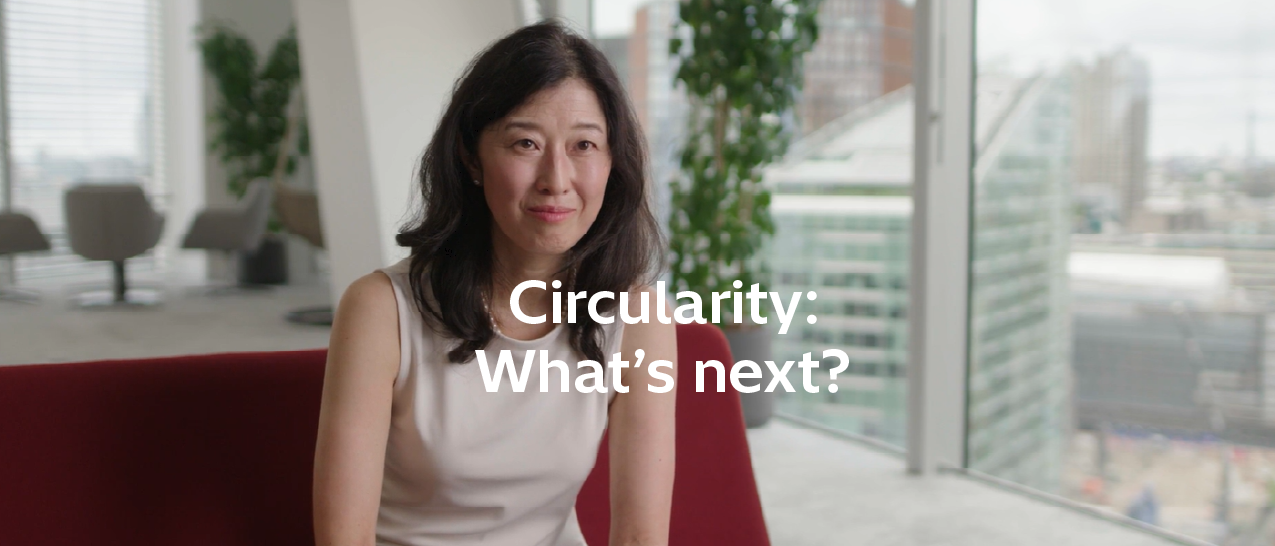
What’s next for circularity? Powering a more resilient Europe
Circularity is about more than recycling. For Europe, keeping infrastructure in use for longer through reuse, repair, maintenance and life extension can reduce resource use, strengthen supply resilience and create long-term value.
Maiya Shibasaki, Chief Sustainability Officer, Hitachi Rail, explains Hitachi’s approach to circularity and how digitalization and AI are helping to make it possible.
Why does circularity matter for Europe?
Demand for clean energy and sustainable mobility is rising across Europe, while access to raw materials is becoming less predictable. Circular practices help close that gap by preserving the value of the materials and assets already in use, rather than relying on a supply of new ones.
Circularity is not only an environmental goal. It is also a route to greater resource security and a more competitive European industry.
How can digitalization and AI extend the life of assets?
Data and AI allow us to monitor the condition of assets in real-time. Operators can predict when maintenance or repair is needed, rather than replacing parts on a fixed schedule or after failure.
Hitachi’s HMAX platform, for example, creates a digital twin of the rail ecosystem, bringing data from trains, signaling and infrastructure to enable predictive maintenance and smarter decision-making. This extends asset life while reducing material use and operational costs. From 2027, all new Hitachi rolling stock, signaling and infrastructure will be equipped with HMAX sensor technology.
How is Hitachi putting circularity into practice in Europe?
Across Hitachi, circular practices are being applied throughout the lifecycle, from design to second life. Hitachi’s approach focuses on three areas of innovation:
- Product design: designing products to use fewer resources and last longer.
- Manufacturing: improving production processes to reduce waste and use materials more efficiently.
- Business models: developing services that maximize the value of products across their lifecycle.
This supports Hitachi’s long-term goal of achieving a circular transformation by fiscal 2050, and the approach is already being applied across Hitachi’s businesses in Europe. Two examples show how it works at different stages of the lifecycle. At the design stage, Hitachi Rail applies eco-design principles to all new vehicles and uses an integrated life cycle assessment (LCA) program to measure environmental impact from materials and manufacturing through to operation and end of life. At the other end of the lifecycle, Hitachi Energy has modernized and refurbished two 50-year-old power transformers from Helsinki’s former Hanasaari coal-fired power plant in Finland, giving them a second life at energy company Helen’s new electric boiler plant, which will provide district heating for the city using fossil-free electricity.
What’s next? Turning circularity into a competitive advantage for Europe
The most sustainable asset is one that keeps performing, evolving and delivering value for years to come. By combining engineering expertise, digital technology and lifecycle thinking, Hitachi is working with customers and partners to keep Europe’s critical infrastructure performing for longer, helping to build a more resilient and resource-efficient Europe.
You may also like

Discover how we are driving what’s next for society.


European Headquarters
Hitachi Europe Limited
Ditton Park
Riding Court Road
Datchet
Slough, SL3 9LL, United Kingdom