

How to make AI agents behave in the physical world
A model by itself does not provide the end-to-end audit trail needed for consequential decision-making in social infrastructure settings.
In partnership with

Driven in large part by ever-growing datasets and LLMs, AI has advanced rapidly across consumer and enterprise platforms. In these environments, the penalty for error is generally small. If a chatbot writes a flawed sentence or a coding tool produces a syntax glitch, a quick re-prompt is all that’s needed to correct it.
Physical AI, however, raises the stakes. Applied to social infrastructure - from power grids and data centers to rail and factory floors - AI is being introduced into environments where hallucinations, drift and bias can have physical consequences, affecting uptime, safety or critical services. The growing autonomy of AI agents compounds the exposure. Hitachi’s argument is that this cannot be solved by model quality alone.
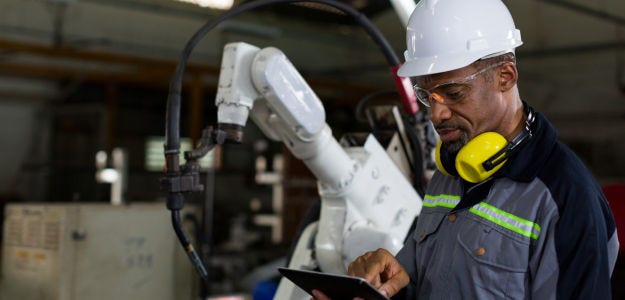
A problem of systems, not models

“The models keep getting better and they’re very good at handling tasks or general knowledge,” says Sudhanshu Gaur, Senior Vice President and Deputy General Manager, Research & Development, at Hitachi America. “But when we talk about bringing that experience from the enterprise to the social infrastructure side, it becomes much more nuanced.”
Frontier models have never seen the inside of a factory. Ask one whether it is summer in Australia and the answer is precise. Ask whether the temperature and vibration readings on a particular motor indicate normal operation or impending failure, and it has no basis with which to respond. The gap is not the model’s fault, Gaur notes: it is doing a fine job on the data it was trained on. What it lacks is any understanding of the customer’s own environment, from the equipment mix and the maintenance record to the knowledge held by people who have run that machinery for decades.
Nor is a dedicated reasoning model for every plant necessarily the answer. “You can build a model that’s trained on each specific ecosystem, but the challenge is that you will end up with thousands of models which are trained on data provided at one instant in time,” says Gaur. “The maintenance, logistics, and economics of small language models just don’t work out. Depending on how it is implemented, that route can also create sovereignty concerns." The durable asset, in Hitachi’s framing, is the operational context, not a particular model.
Industrial operations cannot work with opaque systems either. When an automated line halts or a turbine shows irregular load distribution, plant operators need to know what caused it, and so do the teams accountable for the site. A model on its own leaves no such trail.
For Hitachi, this reframes the discussion. “The question isn’t only whether AI is smart enough,” he says. “It’s whether you can verify what it proposes, show what was checked, and decide whether that class of action has earned the authority to proceed.”
The thread through HMAX
Many early attempts to bring AI into industrial or social infrastructure settings have been tightly integrated around a specific problem. They can work well in a bounded setting, but become difficult to reuse across lines, sites or use cases.
Hitachi’s response is the Integrated World Infrastructure Model, or IWIM, the company’s core technology for Physical AI. As Gaur describes it, IWIM helps AI understand real-world operations and enables customers to model and validate their solutions. It’s an orchestration layer that brings together operational context, AI reasoning and agents, and simulation or validation for consequential actions.
It’s also the thread that runs through HMAX by Hitachi, the company’s suite of next-generation AI solutions. In fact, the company’s newly released HMAX Data Fabric feeds a site’s context information and operational knowledge, as well as equipment models and digital twins, directly into IWIM as essential prep work. As Hitachi adds components to the HMAX portfolio, IWIM will enable them to work as a platform rather than as separate products, delivering outcomes that are auditable, traceable and safe.

“With IWIM, what we’re providing is a much more structured approach, a platform experience where you can build multiple applications on top,” says Gaur. Because the architecture stays modular, operators retain granular traceability and auditability for every component. “This matters because with Physical AI it will not be one vendor which provides the entire stack, including the moving robots,” he says. “If you take the monolithic approach, you just get a faulty outcome and you don’t know what caused it. But with IWIM you know where to troubleshoot if something goes wrong, which is particularly important if it has safety or security implications.”
This can also address sovereignty concerns. Rather than unnecessarily moving a customer’s data to the intelligence, IWIM decouples the two and brings the intelligence to the data, keeping the customer in control of where that operational knowledge lives and which systems can access it.
Weaving a knowledge fabric

The context IWIM works from is what Hitachi calls a knowledge fabric: a structured, living representation of how a site actually operates - what assets exist, how they are connected, what depends on what, their operating limits and history, and the tacit or tribal knowledge built up by the people who run them.
It has two layers. The first is a general template, a working account of how an oil refinery operates or how a metro system runs, which Hitachi builds from its own operating history across those industries. The second is customer-specific, generated by an engine that sits inside the customer’s own IT infrastructure and guardrails and consumes their internal records. The data never leaves.
That second layer draws on AI agents that crawl maintenance logs, incident reports and plant layouts, with further agents assessing how reliable each interpretation is. Where confidence is high, the fabric stands. Where a segment is business-critical but confidence is low, the system flags it and routes it to a human expert. “There are many ways to conduct this outreach,” says Gaur. “It could be someone staring at a dashboard answering questions, getting messages on Slack, or even an agent making a phone call if the organization allows it.”
Context alone does not make an action safe; the loop around it does. Every action an agent proposes is rehearsed first in a digital twin of the site, then verified against the site's rules and evidence, and only then is it released to the control system. "Simulation gives you evidence, not proof," Gaur says. "So autonomy is granted task by task; it is earned, and it can be narrowed or withdrawn as conditions change. Critical or novel actions still need a human to say, ‘Yes.’"
Proof in the field
IWIM was named as an initiative last year, though the work behind it ran for several years across Hitachi’s research operations in Santa Clara and Tokyo. Hitachi is proving it first on its own operations, as what Gaur calls customer zero, and taking it into rail and urban mobility, grid infrastructure, data centers and factory automation through engagements that are deliberately narrow at the start.
In a trial with air-conditioning manufacturer Daikin, Hitachi's AI agent identified the cause of equipment failures and recommended corrective actions within 10 seconds and with over 90% accuracy,1 with the speed and accuracy of experienced technicians. That method, drawings and maintenance records turned into structured context for the model, is what IWIM's knowledge fabric now generalizes.
A powerful example is Japan’s Shinkansen, or bullet train. “We all know that Japan's bullet trains are reliable, safe and on time; the question is how?" says Gaur. "The record is not one technology. It is three things working together: dedicated hardware and train protection, software for operations and maintenance, and what the Japanese railway community calls ‘humanware,’ the skilled people, their training and their judgment. The hardware and the software you can export. The humanware was built by people working on one line for decades. That is the hard part to move."
That is what IWIM is designed to carry. North American plants contend with labor shortages and high churn; Japan faces an aging workforce. By capturing the judgment of long-serving staff as structured context and pairing it with rules that agents cannot cross, Hitachi's contention is that the outcome can travel even where the conditions do not. The company expects to extend the same templates into further sectors, including pharmaceuticals and healthcare.
“You can think of it as AI for managing multiple AIs, and reliably interfacing those with the industrial infrastructure,” says Gaur.
This story first appeared on ReutersPlus
- For a live explanation of IWIM, check out this short video.