




Environmental
Hitachi established its “Environmental Vision” to define and clarify the society which we seek from a long-term perspective, given the trend of deepening environmental issues in the world and its management policy. To realize “Decarbonization”, “Circular Economy”, and “Nature Positive” which are set forth by its Environmental Vision, Hitachi formulated long-term environmental targets called “Hitachi Environmental Innovation 2050”.
(FY 2025)

Achieve carbon neutrality by FY2030 at factories and offices
Among our long-term environmental targets “Hitachi Environmental Innovation 2050”, we have set a goal of achieving carbon neutrality by FY2030 at our factories and offices.
To achieve this goal, we promote initiatives with a roadmap to reduce GHG emissions including CO2 by 50% from the base year in FY2024, 80% in FY2027, and carbon neutrality in FY2030.
As specific measures, we strive to achieve the followings, with particular emphasis on increasing power sources with additionality*1:
- Expanding electricity introduction generated by renewable energy (solar, wind, geothermal, small- and medium-sized hydropower etc.)
- Promoting the deployment of distributed power + next-generation batteries
- Building a Smart Grid utilizing the scale of Hitachi Group
- Giving incentives for energy saving through active promotion of DR (Demand Response)*2 and contributing to the stable supply of electricity to society, etc.

*1 Power sources with additionality
Power sources that contribute to the investment and the spread of new renewable energy.
*2 DR (Demand Response)
Changing electricity demand patterns by allowing consumers to control their electricity usage. This allows balancing the supply and demand of electricity.
Achieve net zero by FY2050 and Reduce GHG emissions by 52% through the value chain by FY2030 (compared to FY2022)
Among our long-term environmental targets “Hitachi Environmental Innovation 2050”, we have set a goal of achieving net zero by FY2050 and reducing GHG emissions by 52% through the value chain by FY2030 (compared to FY2022)
Hitachi is supported by procurement partners which establish and maintain our value chain in wide business areas. It is important for Hitachi to have support from procurement partners and liaise with them to achieve the carbon neutrality through the value chain.

Our initiatives to reduce the upstream GHG emissions in the value chain include Scope 3 Category 1*3, in collaboration with our procurement partners. In May 2025, the revised Hitachi Group Sustainable Procurement Guidelines*4 were released. The updated guidelines clearly outline the Code of Conduct that procurement partners are required to follow in terms of compliance with laws and regulations, and are expected to respond to the Self Assessment Questionnaire (SAQ) and accept on-site audits. New items have also been added, such as respect for land rights and contributions to the circular economy.
These guidelines have been distributed to procurement partners to raise awarness and promote understanding. Also, we requested our procurement partners to measure GHG emissions, set and disclose a GHG reduction goal and promote initiatives to inimize GHG emissions.
In order to calculate GHG emissions of Scope 3 Category 1, Purchased Goods and Services, in the value chain upstream, we use the spend basis method to cover entire group procurement activities and also reflect the primary data obtained from procurement partners into the calculation in part. We ensure that the primary data collection from procurement partners are through our engagement and utilize a third-party sustainability evaluation platform, EcoVadis.
We are also promoting collaboration with procurement partners to reduce Scope 3 Category 1. To encourage GHG reduction efforts among procurement partners, we have engaged in dialogue with 21 partner companies selected in FY 2022 and explored GHG reduction measures, emissions calculation methodologies and approaches to collecting, analyzing and utilizing data. Based on these insights,
the number of procurement partners in FY 2025 that have established GHG emissions reduction targets and implementation plans increased to 428. Futhermore, Hitachi established a decarbonization co-creation partner framework in FY 2025 for procurement partners, particularly small and medium-sized enterprises, based on findings from procurement partner assessments to date. We engage in direct dialogue to support procurement partners in calculating emissions and developing reduction targets and plans that reflect their circumstances. We also support capacity building for our procurement partners by preparing and providing the necessary tools, including practical handbooks on carbon reduction. Going forward, we will expand our support programs by leveraging assistance from public institutions with specialized expertise and practical experience to help procurement partners successfully implement their reduction plans. Hitachi is committed to expanding GHG emissions reduction activities with the goal of having 700 procurement partners establish reduction targets and plans by FY 2027.
Since FY 2023, Hitachi has sourced all newly refined aluminum (Al ≥ 99.7%, standard ingots) procured for use in Japan primarily from manufacturers that produce the material using hydropower and other renewable electricity. This initiative contributes to reducing GHG emissions from products and services purchased upstream in the value chain. We also work with procurement partners to adopt green steel*5 produced using the mass balance approach, as well as recycled materials to support a circular economy. Looking ahead, we will continue to adopt and explore environmentally conscious procurement materials through collaboration and cooperation with our procurement partners.
*3 Scope 1, 2, 3
The GHG Protocol categorizes the direct and indirect emissions into three broad scopes;
Scope 1: Direct emissions from in-house fuel use and industrial processes
Scope 2: Indirect emissions from production of electricity and heat purchased by the company
Scope 3: Other indirect emissions not covered by Scope 1 and 2 (Emissions by other entities related to the company's activities)
*4 Hitachi Group Sustainable Procurement Guidelines
*5 Green Steel: Steel products supplied with certificates indicating the allocation of GHG emission reductions, such as CO2, achieved through additional reduction projects carried out by steel manufacturers. These reductions are pooled and distributed across selected steel products by the manufacturer.

In the Green Procurement initiative, we request our procurement partners to comply with the Guidelines and deliver items relating to the partners' environmental preservation activities (such as establishing an environmental management system and obtaining recommended certifications). In addition, we strive to procure items that have a reduced burden on the environment, for example, items that demonstrate (or are produced by using) the best practices for saving resources, saving energy, recycling, and properly managing the chemical substances in products and providing adequate information.
*1 Green Procurement refers to practices in which parts and materials that have a reduced burden on the environment are purchased from procurement partners engaged in environmental preservation.
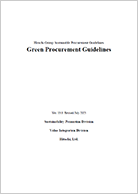
The Guidelines are available in three languages: Japanese, English and Chinese.
Green Procurement System Log-In
Please enter the Portal of Green Procurements for details on chemical substances contained in products.


Sustainability assessments
Starting in FY2022, we adopted the EcoVadis third-party evaluation platform for monitoring and evaluating the sustainability performance of our procurement partners. We perform assessments regarding procurement partners who represent a large portion of our procurement and who are important to our business strategy. We confirm sustainability efforts based on a checklist covering four areas: environment, labor and human rights, ethics, and sustainable procurement. In addition to EcoVadis, we also use the
proprietary Hitachi Sustainability Questionnaire to conduct SAQs across a wider range of procurement partners to expand our sustainability assessment. In FY 2025, we conducted sustainability assessments of 5,090 procurement partners across the Hitachi Group. We use the information obtained from these evaluations to identify companies requiring corrective action, to promote focused improvement and monitorings, and to implement sustainability audits.
We will strengthen measures to steadily assess the sustainability risks of procurement partners, detect
risks at an early stage and drive corrective actions through active engagement with partners.

We also support capacity building for our procurement partners by preparing and providing the necessary tools, including practical handbooks on carbon reduction. Going forward, we will expand our support programs by leveraging assistance from public institutions with specialized expertise and practical experience to help procurement partners successfully implement their reduction plans.
Seminars for Procurement Partners
We held sustainable procurement seminars in an effort to deepen procurement partners' understanding of Hitachi policies and the importance of sustainability.
We invite our procurement partners in Southeast Asia, China, and Japan to the Regional Sustainability Procurement Seminar to address social issues proactively together with our procurement partners. 388 procurement partners participated in the FY2025 seminar. We strive to communicate the Hitachi Group Sustainable Procurement Policy to each region.
In order to read a PDF file, you need to have Adobe Acrobat Reader installed in your computer.


