Company formed. Completed five-horsepower induction motor
1911
Completed 2-kVA transformer
1914
Started production of AC ammeter and voltmeter
1916
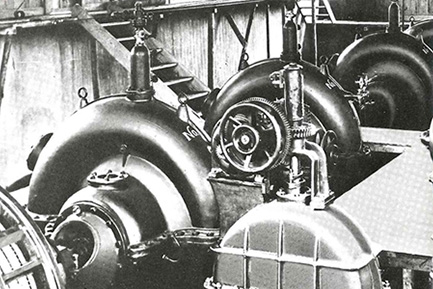
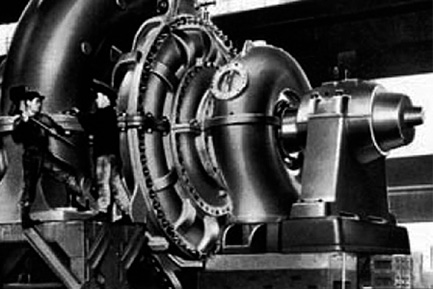
Completed 10,000-hp (7,355-kW) water turbine
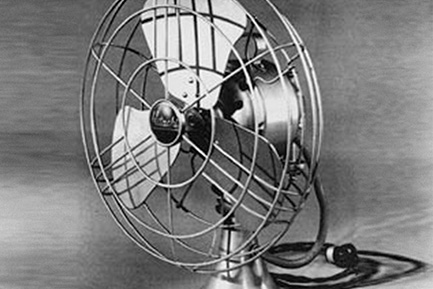
Started production of fans
1918
Large pump production
The early 20th century in Japan, electricity served as the driving force for its modernization.
Hitachi's pump production began in 1907 with The Tokyo Tsukudajima Engineering Works, the company's predecessor that merged with Hitachi in 1918.
When it merged with Hitachi to form the Kameido Works in 1918, it developed a 150 horsepower pump and supplied eight of them, building the foundation for Hitachi's large pump manufacturing. Since then Hitachi has built pumps for a wide range of needs, including mining, civil engineering, water and sewage services, agriculture, buildings, factories, and households.
1924
Japan's First Large Electric Locomotive
Japan's first railroad opened in 1872, connecting Shimbashi and Yokohama. The railroad became a symbol of civilization and culture, and expanded as it supported new nation-building efforts during the Meiji Era, with the Tokaido Line fully opening in 1889.
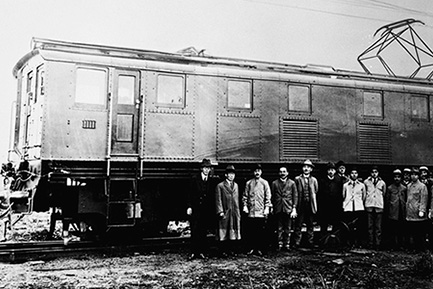
The Ministry of Railways was established in 1920 to set up a plan for electrification of the Tokaido Line. At that time, all large electric locomotives in Japan were foreign-built trains. Making domestic train production its mission, Hitachi brought all of its might together to take on development of a large electric locomotive. Although its previous experience was in building electric locomotives for mining, in 1924 it made successful test runs. The ED15 developed through this project became known as Japan's first large electric locomotive.
The news that a large electric locomotive had been manufactured in Japan received widespread attention, including coverage in American newspapers. Hitachi would later build an exceptional track record of delivering electric locomotives and further refine its railcar technologies.
Completed the first large-scale DC electric locomotive to be manufactured in Japan
1926
Hitachi Exports its First Electric Fan
In contrast to its success with large products, the Hitachi Works had been struggling with development of electric fans for mass production since 1916. Efforts to perfect development were hampered by difficulties with the oscillating mechanism, which made the fan too noisy.
In 1926, ten years after development began, Hitachi finally successfully mass-produced its electric fan. As many as 5,500 units were manufactured in that year. Thirty of these were exported to the United States, making this Hitachi's first export product. The Hitachi fans used proprietary technology and did not rely on American or European patents or methods, so they were not hampered by export restrictions. This enabled Hitachi to send the fans to regions such as India and Southeast Asia.
1930
Started production of pole-top transformers
1931
Completed 10,000-A hydraulic electrolytic cell
1932
Started production of elevators
Completed Hitachi's first electric refrigerator
1933
First passenger elevator
Hitachi began its research and development of elevators in 1920, shortly after its founding. In 1932 it officially launched the production of elevators, and the following year supplied its first passenger elevator to the Towa Apartments. It could carry up to five passengers and traveled at 30 meters per minute.
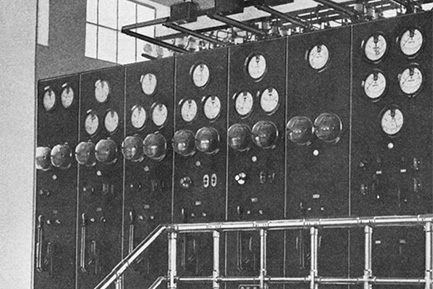
Delivery of electric system control panels to Kanamachi Water Purification Plant in Tokyo
Water supply systems, which purify water from rivers and other sources and supply it for drinking and household use, were first introduced in Japan during the Meiji Period. Back then most people drew water for household use from wells, but as urban populations increased, modern water supply systems gradually took shape.
The Kanamachi Water Purification Plant began operations in 1926, supplying water to East Tokyo in the region that is now Katsushika, Adachi, and Edogawa wards, and to this day it treats water for an area covering about one-third of Tokyo's 23 wards. At that time, Hitachi, which was promoting domestic production of industrial products, supplied the plant with pumps and electrical equipment. The electrical system control panels Hitachi delivered in 1934 allowed facility operators and switchboard monitors to work together, making pump operations more efficient. This milestone launched the monitoring and control systems that support the advanced waterworks systems we use today.
The company delivered its first escalator in 1936 to the Daitetsu Department Store in Osaka, which would later become the Kintetsu Department Store. It was narrower than today's escalators and was made with teak wood for the railings and Bakelite for the steps.
At a time when industry was advancing and new cultures such as department stores and Western foods were blossoming, Hitachi elevators gave a boost to the modernization of cities and daily life and brought greater enrichment to the lives of Japan's citizens.
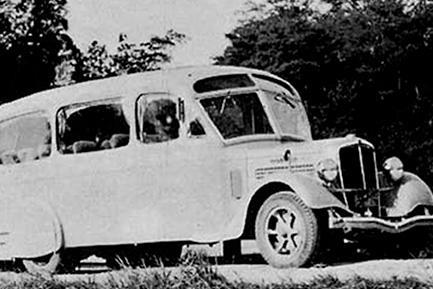
In the latter half of the 1910s, American automakers established mass production through assembly line work and worked to popularize the automobile. In Japan, domestic auto production began in earnest in the 1930s, mostly for trucks and buses.
Hitachi completed its four-cylinder, 60HP diesel engine in 1931 and supplied it to automakers. In 1936, it developed its own diesel bus and truck, and exhibited them at an auto show at Hibiya Park in Tokyo to great acclaim. Hitachi would go on to command a 75% share of the domestic diesel bus market. It's worth noting that Hitachi's first diesel bus was used to shuttle employees between factories.
Completed 85,000-kW Francis water turbine and 70,000-kVA alternating current generator
1949
Completed first U05 power excavator
1951
Completed 6,500-kW Kaplan water turbine and 7,000-kVA AC generator (first umbrella-type generator made in Japan)
1952
Large pumps for pumped storage power station
In the 1950s, electricity in Japan was mainly generated from hydraulic power using dams. This led to frequent power outages due to insufficient supply, pumped storage power generation scheme using water lifted by large pumps supplemented power shortage.
The massive 21,000kW pump at the pumped storage power station built on the Tadami River in Fukushima prefecture began operations in 1952. This revolutionary pump, Japan’s largest in both size and output at the time, received high marks.
Since then Hitachi has built up its track record in large pumps, earning recognition both inside and outside Japan.
Completed 21,000-kW two-stage pump-turbine
1953
Completed true low-pressure 300-m3/h air separation machine
Completed 55,000-kW hydrogen-cooled turbine
1954
Completed the first large-scale cold strip mill to be produced in Japan
1955
Crossbar switching system
Fixed telephone subscribers in Japan took off in the early 1950s. Back then connections for local calls were automated, but long-distance calls still required manual connections by operators, resulting in long connection times. Automatic switching systems of the time were also difficult to maintain. This is why Nippon Telegraph and Telephone Public Corporation began to consider development and adoption of crossbar switching systems.
These systems featured switches at the intersections (cross) of metal rods (bars) arranged in a horizontal and vertical grid. When information in the form of a dialed phone number was transmitted, magnetic force caused the bars to touch and connect the call. Hitachi also developed a system using its own technologies, and in 1955 it completed its first private branch exchange for an electric power company. Later, Hitachi and Nippon Telegraph and Telephone Public Corporation would develop a lighter and more economical crossbar switching system called the C400, which became widely adopted by telephone companies starting in the latter half of the 1960s. This contributed to domestic telephone demand and service improvements.
Completed 100,000-kW Francis water turbine and 93,000-kVA alternating current generator
1956
Completed the first DF90 diesel-electric engine to be built in Japan
1958
Completed six-transistor miniature portable radio
HS-6, HM-3 Electron microscopes awarded the grand prix at the World Exposition in Brussels
1959
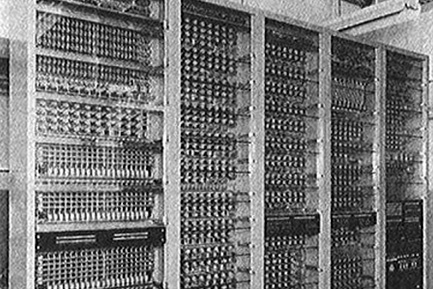
Completed electronic computers based on transistors
Hitachi America, Ltd. established
1960
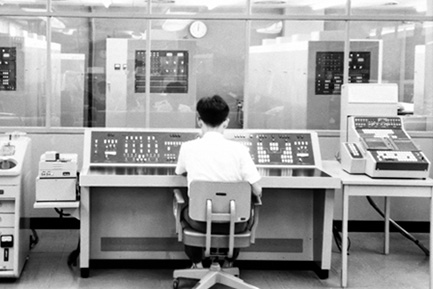
MARS, the world's first seat reservation system
The prototype of Japan's famous Midori-no-madoguchi service counters is MARS*, the world's first online seat reservation system, which was introduced in 1960.
At the time, Japan was experiencing tremendous economic growth. Trains received a sharp increase in passengers, and people could be seen lining up for hours at stations waiting for tickets during peak seasons such as New Year's and the summer Obon holidays. Because reservations and ticketing were carried out by employees using ledgers, the difficulties in judgment made problems frequent. In order to computerize these tasks, Hitachi came up with the test machine MARS-1 in 1960 under the guidance of the Japanese National Railways (JNR). This enabled employees to check seat availability, make reservations and issue tickets in real time.
MARS-101 was completed by the time the Tokaido Shinkansen opened in 1964, and the following year the Midori-no-madoguchi service counters were opened in major JNR stations. By 1968 seat reservations could be made for any line from all stations in the country. Today the system is used for a wide variety of services, from basic fare and super express tickets to commuter passes and tickets for special events.
*MARS: Magnetic-electronic Automatic Reservation System
MARS is a registered trademark of Railway Information Systems Co., Ltd.
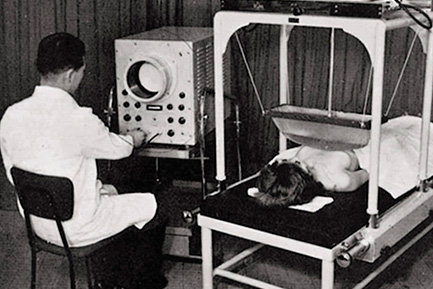
World's First Diagnostic Ultrasound System
To see areas inside the body that couldn't be seen from outside - this was a dream in medicine, and the diagnostic ultrasound system made it possible with the power of ultrasonic waves, which were also used by fish finders.
This breakthrough medical device visualized the reflections of ultrasonic waves projected onto the human body as waveforms and images. It was first introduced to the world in April 1960, and the company that succeeded in commercializing it was the company that had been involved in R&D toward early detection of malignant tumors: Hitachi.
Around this time mortality rates from cancer had just started to climb in Japan, and mass screenings using X-rays for early detection of cancer had begun throughout the country. The ultrasound system would become Japan's first mammary diagnostic system, and when it first appeared it established the foundation of ultrasonic diagnosis, which enabled monitoring of subtle changes in human tissue and facilitated early detection of many kinds of diseases.
Developed cubic-type refrigerator
Completed seat reservation system (MARS-1) for Japanese National Railways