Succeeded in world's first micro-level observation of magnetic field by the use of electron beam holography
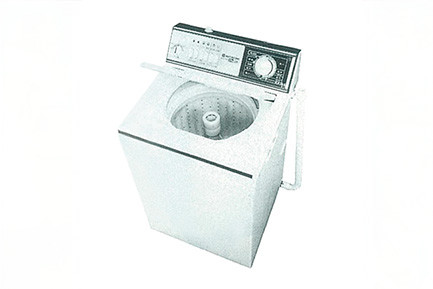
Fully automatic washing machine with tangle-free bar
Around 1980, the impeller-type was the trend in fully automatic washing machines in Japan, but as technology evolved, machines became able to produce a high-speed rotating flow of water. While this style could wash clothes in a shorter time, it presented challenges such as tangled clothes and damaged fabrics. Hitachi responded by commoditizing its revolutionary idea to place a bar in the center of the washing tub, creating a separate water flow and preventing clothes from getting tangled. It was introduced to the market in 1982 with a name that means "tangle-free bar."
With its unique name as well as a distinctive TV commercial, this washer attracted a great deal of attention within the market. At the time twin-tub washing machines were still mainstream and fully automatic washers suffered from stagnant demand due to their positioning as a luxury product, but this turned everything around. Around this time a shift began in Japanese consumers' washing habits from "washing because it's dirty" to "washing because it was worn," leading to larger loads and greater popularity for time-saving fully automatic washers.
1983
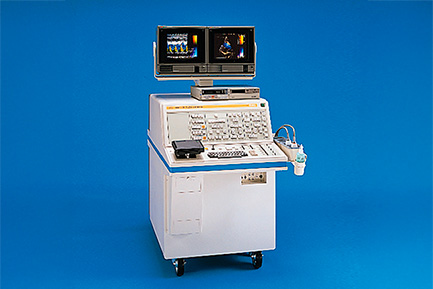
World's First Color Doppler Technique
After their introduction, diagnostic ultrasound systems continued to improve in function and performance, becoming so widely used that doctors called them their "second stethoscope." Entering the 1970s, the demand rose for advanced scanners that could diagnose not only changes in human tissue, but also its dynamic state and function.
In 1983, Hitachi succeeded in commercializing a scanner that could show the state of blood circulation while observing a tomographic image. This product utilized the Doppler effect, best known for the example of an ambulance siren's pitch getting higher when it is close and lower as it goes farther away. This breakthrough diagnostic method could generate images of blood flow within the heart in real time.
Diagnostic methods using the Color Doppler technique would come to play an even greater role in healthcare, being used not only for cardiovascular diagnosis but also in a wide range of other fields, including abdominal, cranial, and OB/GYN for early detection and preventive diagnosis of disease.
Developed air conditioner with scroll compressor
1984
Completed first improved standard BWR to be made in Japan
Started mass production of 256-kbit DRAMs
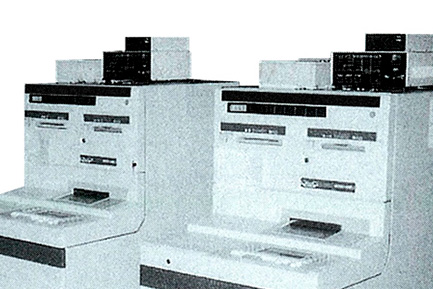
First cash recycling ATM developed
As ATMs spread from the 1970s to the early 1980s, more and more users came to depend on them. ATMs during this time handled deposited banknotes and dispensed banknotes separately, but as the machines became more widely used, operators had to replenish banknote stocks and collect deposited notes more frequently. To save this time and effort, a cash recycling ATM that could dispense the banknotes it collected was introduced in Japan.
In 1984 Hitachi developed the HT-2805, its cash recycling ATM. It became widely adopted by Japan's city banks (now called "mega banks") as well as local banks, dramatically improving the cash handling efficiency of ATMs.
In addition, Hitachi took the initiative in designing cash recycling ATMs for the global market. In 2000 Hitachi developed a cash recycling ATM that could handle bank notes in other countries and regions with different sizes and types of paper, providing ATMs with advanced technologies that could smoothly feed, accurately identify, and neatly align and stack the banknotes used by the region. This ATM spread worldwide, particularly in China, India, ASEAN countries and other parts of Asia.
Today Hitachi's revolutionary cash recycling ATMs contribute to greater convenience for customers and better efficiency for financial institutions in Japan and throughout the world.
ATM: Automated Teller Machine
1985
Completed the "JT-60" large-scale Tokamak device for break-even plasma experiments
Developed CAD/CAE system with ultra-high resolution color display
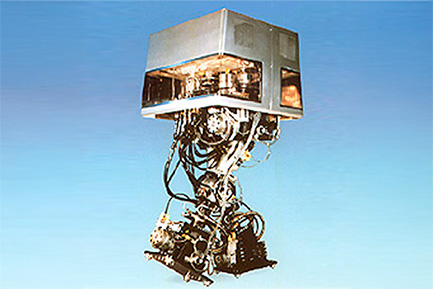
biped robot, WHL-11
Since robots began appearing in TV anime and other places in the 1960s, the real world has been filled with robotics research and development projects aiming to replicate human intelligence and movement capabilities. As a pioneer in robotics research in Japan, Hitachi first worked on a number of robots equipped with arms for the industrial sector. It then took the next step toward mobility, and in 1985 teamed with Waseda University to develop the WHL-11 (Waseda Hitachi Leg 11) biped robot.
The WHL-11 marked the first biped robot co-developed by a major manufacturer. It was capable of "self-supported walking," with all functions other than its power source contained within the robot's body.
It was exhibited at the 1985 International Science and Technology Exposition (The International Exposition, Tsukuba, Japan, 1985) and walked continuously for a total of over 60 kilometers at the venue without any trouble.
1986
Completed HITAC M-68X series
1987
Practical application of predictive fuzzy control
Completed large display using color liquid crystal projection
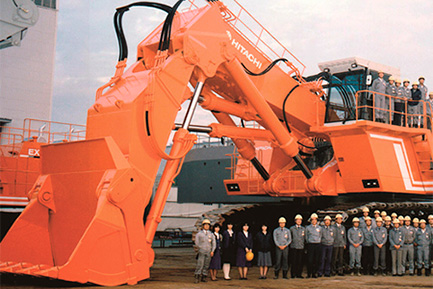
Ultra large hydraulic excavator developed
After the 1970s, as construction projects increased in scale along with economic and industrial development, Japan faced a growing need for even larger hydraulic excavators. Outside of Japan countries started using the open-pit mining method, in which mines are accessed from the ground without digging a tunnel, and this also led the push for larger hydraulic excavators.
In 1979 Hitachi forged a new path in large hydraulic excavators with the development of the 159ton (operating mass) UH50 and the 173ton UH801. Then in 1987, it developed the ultra large hydraulic excavator 328ton EX3500, which in addition to mining work was mounted on a ship and deployed for landfill sediment lifting work for Kansai International Airport.
Various challenges had to be tackled when building larger hydraulic excavators, including making the hydraulic equipment larger and developing electronic control systems. Hitachi employed a range of technologies to solve these problems, and succeeded in improving reliability and durability.
Given their legendary performance, Hitachi is increasing the size and introducing new models in its ultra-large hydraulic excavators as they are deployed at mines throughout the world.
1988
Developed quadrapedal robot
Hitachi Asia Pte. Ltd. established
1989
Developed world's fastest superconductive computer
Developed superconductive MR imaging equipment
Established two R&D centers in the U.S. and two laboratories in Europe
1990
Released very large-scale computer with the world's fastest processing speed at that time
Developed high-resolution TFT color liquid crystal display
1991
Developed inverter-controlled electric locomotive with the world's largest control capacity
Developed highly sensitive image pickup tubes
1992
Completed core network 500-kV substation system
Developed core technology for atomic manipulation and observation of atomic arrangement using scanning tunneling microscope
1993
Developed Shinkansen (Bullet Train) with new maximum service speed of 270 km/h
First in world to successfully demonstrate operation of single-electron memory at room temperature
Developed capillary array DNA sequencer
Participation in HIMAC construction
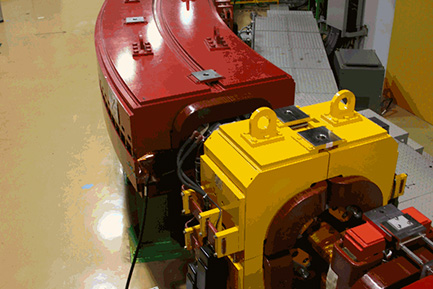
Cancer became the leading cause of death among Japan's population in the 1980s. In light of this, the Japanese government implemented its Comprehensive 10-year Strategy for Cancer Control in 1984. Part of this strategy was the launch of a construction project for the National Institute of Radiological Sciences's Heavy Ion Medical Accelerator in Chiba (HIMAC).
Particle therapy is a treatment that irradiates affected areas with carbon ions or protons (hydrogen nuclei) to destroy or eradicate cancer cells. One feature of this treatment is that the particle speed can be adjusted based on the treatment site depth, enabling pinpoint targeting. Hitachi was asked for the technology of the design and manufacturing of component devices (electromagnet, control unit, etc. for accelerator and nuclear fusion) used in the high energy physics experiments required for particle therapy. The company became involved in the project and handled development of the main accelerator (synchrotron) and total control system. HIMAC was completed in 1993 and clinical trials for cancer therapy began the following year.
Photo provided by Courtesy of the National Institute of Radiological Sciences
1994
Hitachi (China) Ltd. established
Developed the original 32-bit RISC processor SuperH family
Developed clean ATM
Successful prototype of 1-Gbit DRAM
1995
Developed Super TFT LCD module featuring ultra-wide viewing angles
Developed 10-Gbit/s fiber optic transmission equipment
Developed MULTI 2 encryption algorithm
1997
Developed core technology for 4.7-Gbyte DVD-RAM
Developed magnetocardiography technology for scanning cardiac patients
Developed small proton accelerator for cancer treatment
Successful imaging of finger veins with near infrared light
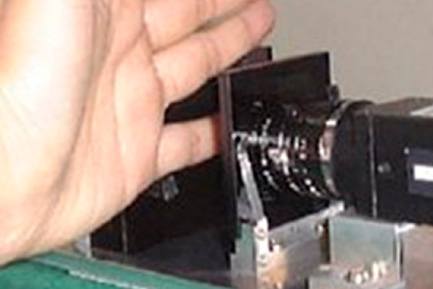
Biometric authentication technology is the use of fingerprints, irises, and other unique physical features as data to verify a person's identity. In the 1990s, as the concept of security began to gain greater importance, Hitachi launched development of a new biometrics technology. This was finger vein authentication, which took advantage of the characteristic of veins to appear darker when the body is photographed using near infrared light.
This technology authenticates an individual's identity by extracting a finger vein pattern from an image captured using near infrared light and comparing it with previously registered images. Finger vein images were successfully captured in 1997, the year the research began, but numerous hurdles were anticipated before the technology could be put to practical use. However, Hitachi saw the technology's resistance to forgery and spoofing and the exceptionally high degree of accuracy, so it decided to actively pursue its research.
Developed 320-Gbit/s optical data transmission system
Developed refrigerator/air conditioner with PAM control
Production System Incorporating Information Integration
The Uruguay Round multilateral trade negotiations in 1995 started a phased reduction of tariffs, and this wave of trade liberalization had a huge impact on the Japanese food industry.
For example, the dairy industry, facing competition from imported products, implemented a government-led reorganization and integration of dairy facilities to strengthen competitiveness of Japanese products.
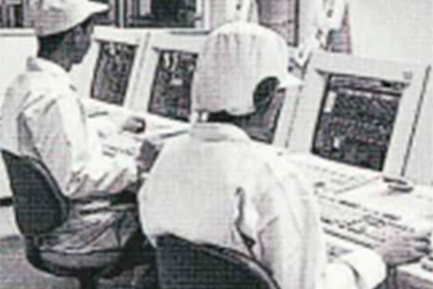
The Kyoto Plant of Snow Brand Milk Products Co., Ltd. (now MEGMILK SNOW BRAND Co., Ltd.), which started operations in 1998, was one of the largest plants constructed as part of this trend. As it employed the newest high-capacity manufacturing equipment, the company also introduced Hitachi's production system incorporating information integration for the purpose of maintaining product freshness. This system connected orders, production, and logistics over a network, vastly improving efficiency in production management. The "gourmet boom" Japan was experiencing at the time led to a system that could answer consumer demands for greater freshness.
The need for safety in food products continues to grow. To ensure a stable supply of safe and reliable foods for consumers, Hitachi is working with its partners to create even more innovative integrated production management systems.
1999
Commercialized lithium secondary battery using manganese system
2000
Developed 52.5-Gbits/in2 perpendicular magnetic recording method
Developed holographic electron microscope with 49.8-picometer resolution
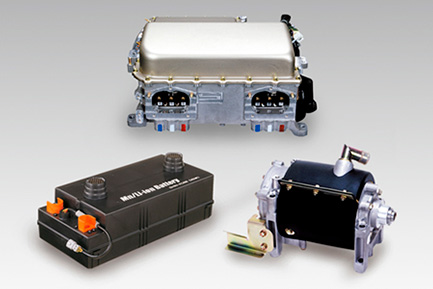
Delivery of hybrid car systems begins
In the 1990s, reducing the environmental impact of emissions from cars became a global concern. This led to the introduction of electric vehicles (EV) and hybrid electric vehicles (HEV) that release no emissions at all while running, bringing rapid progress in the electronic control and electrification of cars.
Utilizing its motor technologies developed through years of experience in several businesses such as railways, Hitachi promoted the development of electric powertrain systems using motors, inverters, and lithium-ion batteries in addition to technologies focused on conventional gasoline engines. It began delivering these hybrid car systems in 2000, and since then has worked to make them smaller and more efficient. Today Hitachi is advancing electric technologies for cars in an effort to find solutions to environmental problems such as global warming and air pollution.