Completed the first cars for the Shinkansen (Bullet Train)
Manufactured monorail running between Haneda Airport and Hamamatsu-cho, Tokyo
1965
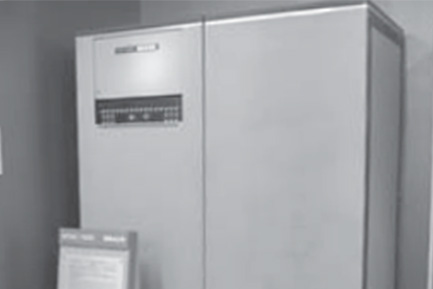
Completed HITAC 5020 system
Completed 19-inch 90° polarized color cathode ray tube using rare earth fluorescent elements
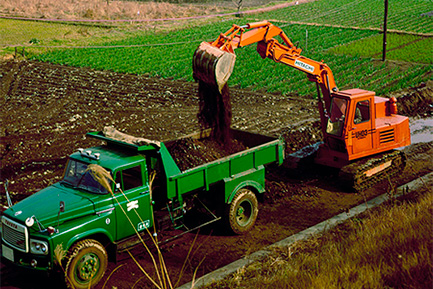
First hydraulic excavator developed with exclusively Japanese technology
As Japan entered its high economic growth period in the 1960s, rapid advancements in social infrastructure such as roads, railways, ports and dams, along with housing development and company factories, buildings and other industrial infrastructure led to a sharp increase in construction work.
In response to this increasing demand for building, construction machinery manufacturers started working to enhance product performance. With excavators, they shifted from mechanical models that had been mainstream, to hydraulic models that European and American manufacturers were making. Hydraulic models were more compact and easier to operate than mechanical ones, and excelled in excavating capability and maintenance.
As numerous manufacturers forge technological partnerships with European and American companies to develop hydraulic excavators, Hitachi took on the challenge of developing its technologies in-house, and in 1965 developed the UH03, the first hydraulic excavator made exclusively with Japanese technology. Its outstanding reliability and performance earned it an excellent reputation, and it laid the foundation for the Hitachi UH Series that would expand to over 80 countries. In 2011 it was certified as "Mechanical Engineering Heritage No. 48" by the Japan Society of Mechanical Engineers.
1966
Developed LTP processing technique for silicon transistors
1967
Developed dry-type room air conditioner
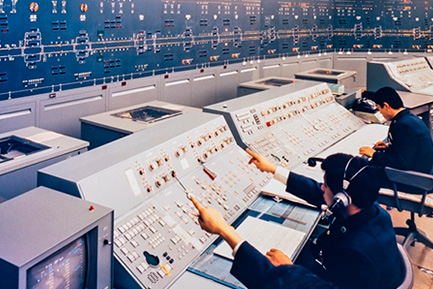
Comprehensive Production Technology Management System for Steelworks
From railways and automobiles to household appliances and other precision machinery, industrial products are all around us in our daily lives. How can manufacturers make products more efficiently and with better quality? The key to making manufacturing smarter lies in the control technologies that make factory equipment and systems work. Control systems built utilizing a diverse array of technologies with durability and reliability for working under harsh factory conditions play a central role in manufacturing.
In 1967, Hitachi delivered its HITAC 7250 large electronic computer to the Sakai Works of Yawata Iron & Steel Co., Ltd. (now NIPPON STEEL CORPORATION). This made real-time plant control, which had long been a challenge, a real possibility. Later this technology would be delivered to the electric power sector for tasks such as power generation and power grid monitoring control, and to the railway industry for rail operation management. In 1969, Hitachi built a specialized factory in Omika, Hitachi City to accommodate the expansion of its control systems business.
1968
Developed hybrid LSI
Completed HIDIC 100 electronic computer for control applications
Developed 300-m/min elevators for high-rise buildings
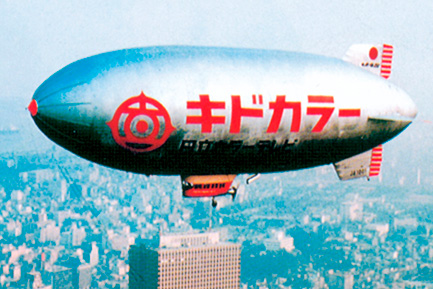
The Kido Color Blimp
In 1958, Hitachi developed the first color cathode ray tube (CRT) manufactured in Japan. When color TV broadcasts began in 1960, it released 21-inch and 17-inch color TV sets. Color televisions were not within reach for most people, but Hitachi's endeavors to make them more affordable contributed to the spread of the medium.
In 1968, Hitachi launched a distinctive red color CRT set nicknamed "Kido Color," which was applauded for its clear color images.
To spread the word about this groundbreaking color TV set, Hitachi chartered one of the only three airships in use in the world at the time. The Kido Color Blimp was emblazoned with the Hitachi logo and Kido Color name, and it flew over Japan playing the song from the TV commercial, making the product a household name.
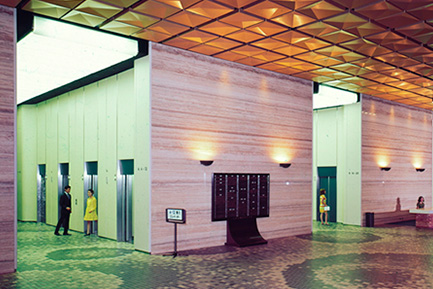
Japan's fastest elevator in the Kasumigaseki Building
In 1968, in the midst of Japan's high economic growth period, the Kasumigaseki Building, a 147-meter tower with 36 above-ground and 3 below-ground floors, was built in Tokyo's Chiyoda Ward. Japan's tallest skyscraper at the time, it adopted the latest earthquake-resistant construction, building methods and facilities.
Hitachi supplied the building with an ultra-fast elevator appropriate for this state-of-the-art building. The fastest elevator in Japan at the time, it traveled at 300 meters per minute. On busy days the elevator carried 10,000 people, from office workers to visitors ascending to the top floor to enjoy the views from the observation deck, to the building's many floors quickly and comfortably.
The Kasumigaseki Building served as a pioneer for the many skyscrapers that would later be built all over Japan. Elevators are an essential part of buildings, and Hitachi has helped builders reach greater heights through its innovative technologies.
Automotive technology center established
In the mid-1960s, during the height of Japan's economic growth period, the country's transportation network rapidly took shape with the opening of the Meishin Expressway and other routes. Color televisions, air conditioners, and private cars, considered symbols of wealth and comfort, were called the "new Three Sacred Treasures." In particular, automobile ownership began to spread among general households, ushering in Japan's private car era.
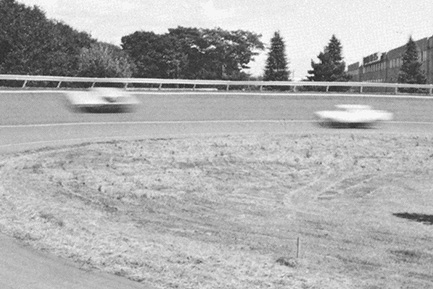
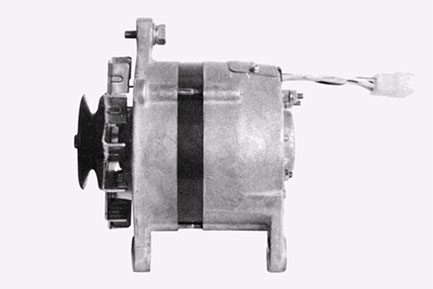
Hitachi had been developing electrical equipment since before World War II, and in 1968, as domestic automobile production surged, it established Sawa Works in the city of Hitachinaka in Ibaraki Prefecture. As the company's main development center for automotive technologies, this plant has been used to develop automotive products such as electrical equipment, generators, air conditioners, and sparkplugs.
Hitachi took the lead among the era's parts manufacturers by setting up a full-fledged, two-kilometer test course on the plant's premises. This course is still being used today for test runs to verify the safety of parts. The spirit of building safe and comfortable cars that was spawned by the Sawa Works has been carried on to this day.
1969
Completed on-line banking system
Developed and mass-produced all-transistor color televisions
Developed Lo-D 2-Way speaker system
1970
Developed computer-aided traffic control system for the Shinkansen (Bullet Train)
Hitachi Group Pavilion at Expo '70, Osaka
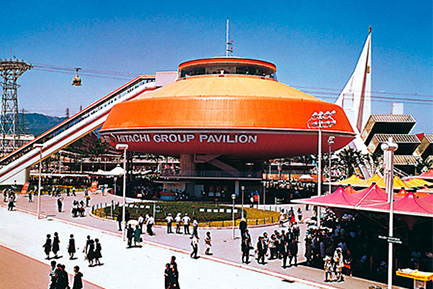
The World's Fair in 1970, commonly known as the Expo '70, was held in Osaka with the theme of "Progress and Humanity for Mankind." A total of 77 countries took part with a wide variety of exhibitions. An unprecedented 64 million visitors came to see the Expo's popular attractions, including artist Taro Okamoto's giant sculpture "The Tower of the Sun" and the NASA exhibition Moon Rock.
Hitachi helped to shape the image of future urban life by contributing a monorail that circled the Expo grounds, along with the "auto line" moving walkway and a district heating and cooling system. The Hitachi Group Pavilion was a red circular building that featured a giant 40-meter escalator connecting the ground floor and upper floor observatory, along with a huge circular double-deck elevator that could hold 260 people and a massive laser display. The Pavilion proved to be very popular, welcoming 1,440,000 visitors over the duration of the Expo.
The Pompa Train
Early color television sets used vacuum tubes, which took more than ten seconds to show an image from when the set was turned on.
In 1966 Hitachi was working on the first black-and-white television set in Japan that would replace the vacuum tube with a transistor. Utilizing its technology and experience, it released the industry's first 19-inch all-transistor color television set in 1969. In addition to the benefits of the transistor, it preheated the CRT while off, so with a flick of the switch ("pom") the image would appear ("pa").
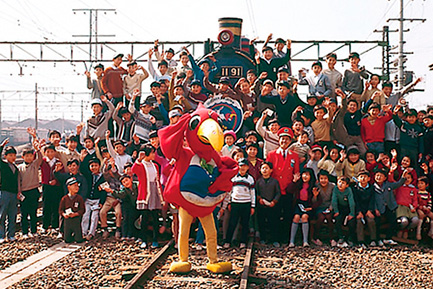
This novel mechanism earned the TV its nickname "Pompa," and it quickly became a huge hit. In 1970 Hitachi began sending the Pompa Train, a steam locomotive that served as a mobile showroom for its home appliances, around Japan, helping the company to earn the top market share.
1971
Completed large (1 Gbyte) file storage unit
1972
COMTRAC Tokaido/Sanyo Shinkansen Control System
Railway control systems help to ensure the safe and reliable operations of the Shinkansen high-speed railway. Opened in 1964, the Tokaido Shinkansen featured a system through which conductors remotely controlled signals to centrally manage the railway's operations. However, the number of passengers ballooned from around 10 million annually at opening to six times that figure in five years, and the number of trains in operation skyrocketed, placing an ever-increasing burden on the conductors.
This is why the Japanese National Railways (JNR) commissioned development of COMTRAC*, a control system for the Tokaido and Sanyo Shinkansen lines to automate route control for trains using computers. Hitachi jointly developed the system, building and testing prototypes and delivering it to the Shinkansen Tokyo operations center in 1971. The following year the system was adopted in timing with the opening of the Sanyo Shinkansen to Okayama.
Since then, COMTRAC has supported Shinkansen operations across half a century with numerous improvements. This expertise has been passed down to a variety of railway operation control systems.
Developed numerically controlled ruling engine for aplanatic concave diffraction grating
Commercial operation began at Japan's first 460,000-kW nuclear power station
Successful automation of semiconductor assembly (automation of wire bonding for LSIs and transistors)
1975
Developed high-performance heat transfer surface (Thermoexcell)
Developed Hitachi High Crown Control Mill
Completed large M-series computer system
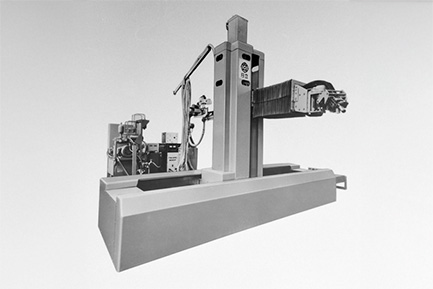
"Mr. AROS" arc welding robot
The postwar steel industry was key to Japan's industrial revival. Once it entered its high economic growth period, Japan would lead the world in steel production volume. Manufacturing of cars, infrastructure, and other large equipment using steel grew rapidly, along with the demand for welding services. However, the industry was plagued by a shortage of engineers. One of the most demanding techniques was arc welding, in which metal is joined using a high-temperature flame from a thin-tipped torch. The work is not only dangerous, but also requires concentration and stamina.
In 1975, Hitachi unveiled "Mr. AROS: Arc welding Robot with Sensors", its breakthrough arc welding robot that was the first in the world to integrate a microcontroller and a magnetic proximity sensor. It could also self-correct as it welded and included features that had been considered difficult to incorporate in machines, such as precise routing control and adaptability to shape errors. This control technology would later be expanded to other applications to support advanced manufacturing in Japan.
1976
Succeeded in trial of world's first optical transmission system
1977
Developed high-speed amino acid analysis machine (type 837)
Completed construction of Fugen advanced thermal converter reactor
1978
Completed world's first field emission electron microscope with record-high resolution
Experimental color camera with solid-state miniature image device developed
1979
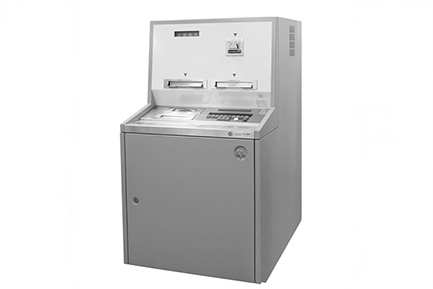
Hitachi's first ATM
In 1969, the first automatic cash dispenser (CD) appeared in Japan, and in 1971 the world's first online CDs were adopted. The technology spread rapidly, and people began using CDs to withdraw cash from any branch of their bank. Back then it was common for workers to receive their salary as a cash payment, so when banks began offering direct payroll deposit services, the use of CDs spread even more rapidly. This led to greater mechanization and automation of customer services at banks.
Next came ATMs, which were CDs enhanced with deposit functions. Hitachi developed an ATM in 1979, and its first ATM (HT-5865) began operating at city banks (now called "mega banks"). Hitachi had previously provided computer systems to support operations at financial institutions, but in order to save labor and ease customer congestion at bank service counters, it focused its efforts on successful development of ATMs. This is how Hitachi entered the ATM business.
As ATMs advance with social changes, they will improve efficiency at financial institutions and contribute to greater productivity across all of society.
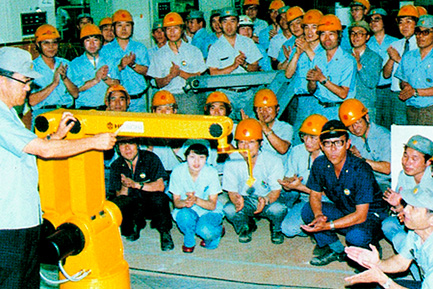
In the 1980s, Japan's manufacturing industry enjoyed tremendous growth, centered around the automotive industry. Domestic automobile manufacturing in 1980 exceeded 10 million cars annually, surpassing the United States to make Japan the world's production leader. Industrial robots helped make this growth possible. Entering the 1980s, robots that could handle more diverse and difficult tasks became indispensable third hands, not only for major manufacturers but also for small and mid-sized companies.
In 1979 Hitachi unveiled its process robot, a multipurpose and multifunction robot equipped with an electrical drive system and the most advanced computing and control technologies of the time, including Hitachi's own robotic language. It could perform different tasks just by changing the parts on its tips, and its advanced functionality supported Japan's manufacturing, earning it an excellent reputation both in Japan and overseas. In 1980 Hitachi manufactured and released the first such robot (pictured). Later the system would be exported to American firms as an OEM* product, leading to a technological alliance with General Electric.
*OEM: Original Equipment Manufacturer
Completed 300-MW AC/DC converter for electricity link between Hokkaido and Honshu