Developed world's smallest 0.3-mm square contactless IC chip
Developed compact DNA analysis system genetic for SNP typing
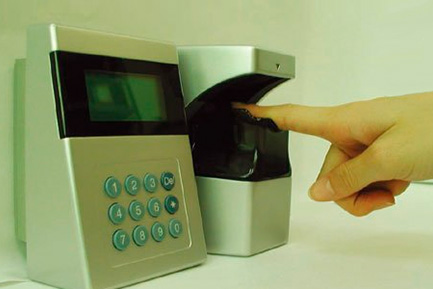
Finger vein authentication for access control systems
In accordance with changes in global circumstances, society and lifestyles in the 2000s, a greater priority was placed on security for entering and exiting airports, offices and other public facilities, leading to an acceleration of research into biometric authentication systems. In 2000, Hitachi led the industry by announcing that it had put finger vein authentication into practical use as an authentication technology. Then in 2002, Hitachi commercialized a finger vein authentication system for use in access control systems.
Even twins have different finger vein patterns. These patterns are not affected by physical health, climate, or skin condition, and they do not change with age. For these reasons, finger veins quickly gained recognition for their authentication security and ease of use. At the same time, devices were being produced in more compact sizes and at lower cost. This has led to the technology's use in identity verification for ATMs*, personal computers, and numerous other aspects of our daily lives.
Developed and commercialized compact, highly accurate, high-speed finger vein authentication system
Successful measurement of infant brain functions using optical topography
Dr. Hideaki Koizumi, a Hitachi Fellow, presented a lecture at the 400th Anniversary of the Foundation of the Pontifical Academy of Sciences, Vatican City
2004
Developed world's smallest sensor-net terminal with a battery life of over one year
Developed high-temperature lead-free solder paste
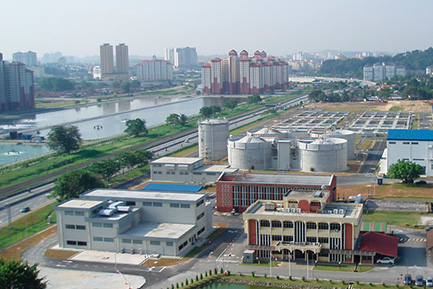
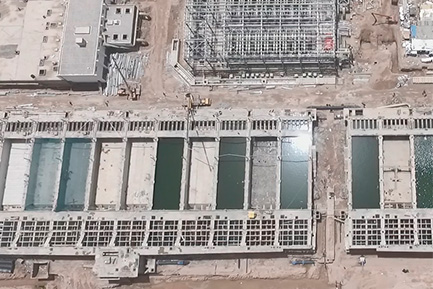
Sewage treatment plant for Malaysia
As emerging nations undergo remarkable economic growth and urbanization, they face urgent needs for infrastructure that keeps up with their progress. Since the 1990s Hitachi has taken part in ODA*1 projects that provide Japanese infrastructure technologies to newly developing countries and regions, as well as EPC*2 projects for developing waterworks.
In 2004, Hitachi began construction of five sewage treatment facilities near the Malaysian capital of Kuala Lumpur. This contributed to improvements in lifestyles, hygiene, and urban environments for about one million people in Malaysia, which until then had only used rudimentary treatment facilities. In addition to the construction, Hitachi also provided training to local engineers in facilities operations and maintenance so that they could keep the plant running.
Through other EPC projects such as the water treatment system in Kandy City, Sri Lanka, Hitachi has applied the water treatment technologies it developed in Japan to countries and regions facing water issues, and provided water infrastructure systems that are suited to regional needs and environments.
*1 ODA: Official Development Assistance
*2 EPC: Engineering, Procurement and Construction
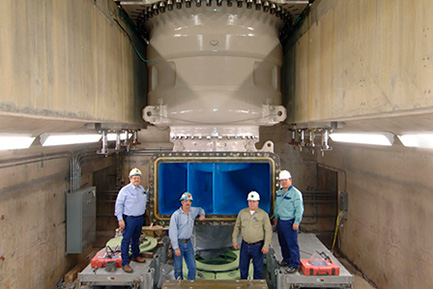
Egypt is covered its most of land by desert, and the merely 6% of the country's area is green space along with the Nile River Basin. For this reason, national greening projects have been developed. The Toshka Pumping Station is one of the key facilities of the project. Its pumps supply water to desert areas from Lake Nasser, the reservoir at the Aswan High Dam built on the Nile. This project will transform the desert to the green area roughly the size of Tokyo to build a new city where three million people can live.
Hitachi had already delivered pumps to several regions of Egypt for drainage and irrigation purpose, and, in 1998, the company joined an international consortium with local Egyptian and British companies, and supplied the 21 large pumps in the Toshka Pumping Station, which was completed in 2004.
Hitachi also supports the greening project by providing operations, maintenance service, and operation training program.
2005
Explosives Trace Detection System received U.S. TSA certification
Exhibited "EMIEW" two-wheel mobile robot capable of direct dialogue at the 2005 World Exposition Aichi, Japan
Established Hitachi (China) Research & Development Corporation
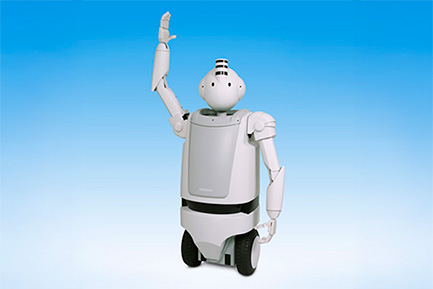
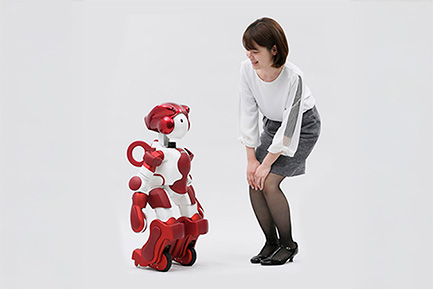
The first EMIEW, humanoid robot
Robots come in many forms, including industrial robots that perform specialized functions in factories, and service robots that coexist with and support humans.
Hitachi has been involved in the development of advanced robot technologies since the dawn of industrial robotics. Anticipating an increase in needs for service robots in the future, Hitachi launched the development of service robotics in 2004, and just one year later completed humanoid robot, EMIEW (Excellent Mobility and Interactive Existence as Workmate).
EMIEW moved on two wheels, and by measuring its body inclination with mounted sensors, it could adjust its velocity to drive in harmony with surrounding people with agility and stability. It had functions such as remote voice recognition and high-quality speech synthesis allowed it to communicate with humans.
At Expo 2005 (the World Exhibition in Aichi, Japan), EMIEW put on an outdoor performance with a human entertainer, attracting lots of attention.
2006
Confirmation of electro-luminescence phenomena on injection of electrical current in ultra-thin silicon film
Basic experiment on the application of Optical Topography as a brain-machine interface
Mass production of 2.5-inch HDD using perpendicular magnetic recording technology
2007
Prototype of world's smallest noncontact RFID powder IC chip (dimensions 0.05mm × 0.05mm)
Prototype of the 2-Mbit non-volatile SPRAM chip using magnetization reversal by spin injection
Developed EMIEW 2, a small and lightweight interactive robot
2008
Developed lithium-ion battery system technology for use in high-speed diesel hybrid trains
Developed technology for small but highly efficient electric motors that do not use rare metals
First commercialization of spot scanning irradiation in the United States
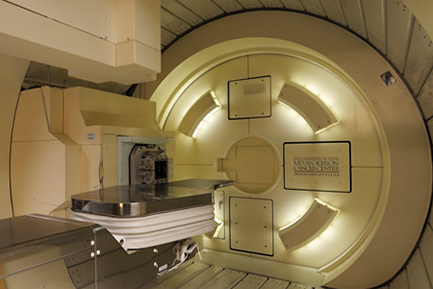
In the 2000s, as clinical trials continued at Heavy Ion Medical Accelerator in Chiba (HIMAC) in Japan, Hitachi's particle therapy development began to attract notice overseas. In 2002, design and production began on a treatment device incorporating spot scanning technology for the MD Anderson Cancer Center, one of the United States' leading cancer treatment hospitals.
Spot scanning irradiation targets cancer with a particle beam according to the tumor's shape. It can target complex shapes with high accuracy and limit the impact on healthy tissue surrounding the affected area. The MD Anderson Cancer Center became the first to apply this spot scanning method to commercial treatment equipment in 2008, and obtained U.S. Food and Drug Administration (FDA) approval. This marked the beginning of commercial spot scanning therapy.
Developed thin-type finger vein authentication technology
2010
Developed power consumption reduction technology for data centers
Developed rare metal recycling technology
Successful control and measurement of spin current
2011
Dr. Hideaki Koizumi, a fellow of Hitachi, made a Fellow of the Chinese Academy of Engineering
Proton beam therapy (PBT) system using spot scanning approved for manufacturing in Japan
Developed technology for increasing speed of wide-area networks (WAN)
Edmonston Pumping Plant in California, U.S.
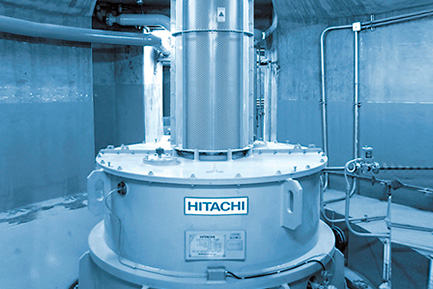
A 960km long water supply line, connecting Northern and Southern California, delivers precious water to major metropolitan areas such as Los Angeles and San Diego, along with Southern California's farm belt. Due to an approximately 600 m height difference exists along this lengthy water supply line, powerful pump capable of both ultra-high pressure and low power consumption is required.
In 2004, Hitachi signed the contract to renovate the Edmonston Pumping Plant, the supply line's most important infrastructure. The company developed an 80,000-horsepower turbine pump, which led one of the world's best efficiency at the time, and supplied four of these to the facility from 2007 to 2011.
Hitachi's pumps achieved excellent efficiency and performance as a result of advanced technologies. These pumps are highly evaluated by California authorities and are helping to ensure water resources in Southern California.
2012
First Practical Field Emission Electron Microscope recognized as an IEEE Milestone
Developed highly efficient industrial-use 11-kW permanent magnet synchronous motor without using rare earth metals
Prototyped automatic human cell-sheet culturing equipment for regenerative medicine
ATOS Tokyo Metropolitan Area Transport Control System
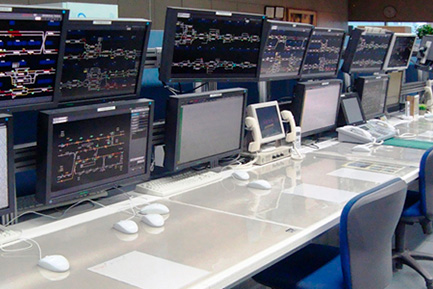
About 14 million people use the rail system in the Tokyo metropolitan area each day, with closely-packed train schedules running as little as two minutes apart. Helping to make these trains run on time 24 hours a day, 365 days a year is the transport operation control system known as ATOS*. Based on a massive amount of schedule information, it controls train operations and quickly restores service when schedules are disrupted, as well as delivering real-time departure time and destination information to display boards installed above station platforms.
The development of ATOS dates back to the 1990s. At that time the Tokyo metropolitan area had a population of more than 30 million, and a massive rail network was built to cover a wide area centering on Tokyo's suburbs. Despite calls to modernize overall operations and control of this network, computerization was thought to be too difficult due to the density of the railways and the complex way the lines intertwined. East Japan Railway Company and Hitachi took on this challenge and completed ATOS in 1996. It brought innovative changes such as automation of route controls, more detailed information for passengers, and greater efficiency in maintenance.
The ATOS system continues to evolve. The system underwent revisions in 2012 with expanded line sections and new functions, along with faster response to operational adjustments with the "predictive schedule function" that forecasts future train service times, and a more comprehensive information service than ever before. The system now encompasses 24 rail lines.
*ATOS: Autonomous decentralized Transport Operation control System
Information is current as of March 2018.
2013
Developed ROPITS single-passenger mobility-support robot
Developed electronic authentication technique based on biometric information
Developed gamma camera for environments with high radiation levels
2014
Developed atomic-resolution holography electron microscope
Developed wearable sensor for measuring organizational activity
Developed walk-through-style finger vein authentication technology
Practical application of Real-Time image Gated Proton Therapy
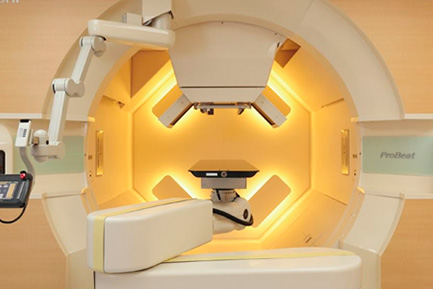
In the 2010s, increasing attention has been given to particle therapy as a less invasive form of cancer treatment. This is because with the significant progress in cancer therapy, there has been greater demand in recent years for improvements in quality of life (QoL) so that patients can lead normal lives during treatment, in addition to improvements in cure rates. Because particle therapy allows patients to continue work and other lifestyle activities during treatment, it is seen as therapy that can help maintain patients' QoL.
The spot scanning technology developed by Hitachi faced challenges in that it was difficult to focus particle beams on tumors that move during respiration, such as those in the liver or lungs. To address this problem, Hitachi and Hokkaido University took on the joint development of a new particle therapy system that combines spot scanning with motion tracking technology to pinpoint organs that change position due to respiration in real time. This Real-Time image Gated Proton Therapy (RGPT) has been in use at Hokkaido University Hospital since 2014.
Most of the water on Earth is salt water from the oceans. The amount of freshwater that humans can use for household is said to be a mere 0.01%. And as the urgency for solving water shortages caused by increasing populations and climate change grows throughout the world, greater focus has turned to water desalination technology, which treats salt water to generate freshwater.
Hitachi has participated in desalination plant projects in India, South Africa, and various island nations since around 2010. In 2014 Hitachi began construction of a large desalination plant in Basrah, a city in southeastern Iraq. In tandem with partner companies, Hitachi received a collective order for desalination plant equipment as well as engineering, procurement, and construction of pretreatment facilities, water intake and transport facilities, and operation and maintenance for five years. This plant will supply the city with freshwater drawn from the Shatt al-Arab River with salt removed using RO filtration*. With water supply capability of 199,000 cubic meters per day — enough for about 400,000 people — it will be the largest facility of its kind in Iraq.
*RO filtration: Reverse osmosis. This membrane allows water to pass but not salt and other impurities.
Developed Hitachi AI Technology/H and launched solutions business using advanced AI technologies
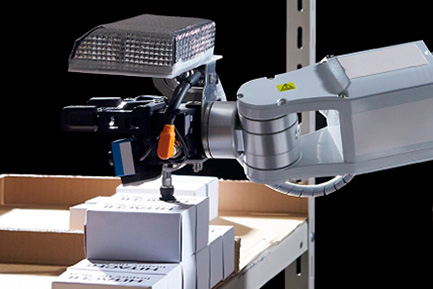
Autonomous mobile dual-arm robot
Logistics plays a vital role as a lifeline supporting industry and individual lives of consumers. In recent years, diversifying consumer needs and the growth of the e-commerce market have made warehouse operations more complex. Large workforces are now assigned to the tasks of finding desired products from shelves stacked with thousands of items in vast storage areas.
Hitachi has been involved in research and development of industrial robots since the 1960s, placing particular emphasis on utilization of intelligence in robotics. In 2015 Hitachi brought its technologies together to create the autonomous mobile dual-arm robot. What makes this robot unique is that it can move quickly and flexibly like a human being. As soon as it moves to a product shelf, its arms recognize the items and begin to move. It skillfully employs both of its arms to pick up the intended product without dropping others from the shelf, and can even pack products into boxes. Once this technology becomes a common feature of warehouses, the dream of the unmanned distribution warehouse will soon become a reality.
2016
Launched "Lumada," which brings together digital technologies and knowledge to create value.
The advanced humanoid robot EMIEW3
EMIEW (Excellent Mobility and Interactive Existence as Workmate), Hitachi's humanoid robot designed to coexist with humans, has evolved to be EMIEW2 that was more compact and lightweight to enhance its practicality and safety and offered enhanced support functions for people, and then became the newest model EMIEW3 in 2016.
Offering advanced service capabilities in a round and adorable form, EMIEW3 can identify and serve customers who need support in shops and other public places, and can provide multilingual information and guide domestic and international travelers to destinations in stations, airports and other facilities. It offers tremendous potential as a partner to support people's daily lives and provide convenience and comfort. Once just a futuristic tale, the world of working robots is now becoming a reality.
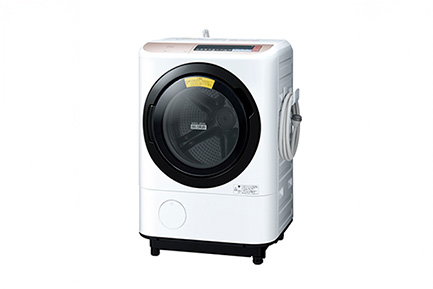
Large capacity front loading washer-dryer with unique drying function
After the year 2000, people demanded more than just basic functions from home appliances; they also called for new value. In washing machines, demand for large-capacity washer-dryers increased, and the new front loading style gained popularity. Amidst this trend, in 2006 Hitachi unveiled a front-loading washer-dryer that featured a large 60 cm diameter drum with a 9 kg washing capacity. It evolved in response to needs for efficiency in both energy use and housework. The 2007 model featured a unique drying function that blow-dried clothes with a wind speed of 360 km per hour (at the time) after washing as it smoothed out wrinkles. It earned an excellent reputation for giving clothes a finish that made them wearable straight from the dryer. Then in 2016, Hitachi released an advanced model with an even larger 12 kg washing capacity, the largest in the Japanease market at that time, which realized a slim depth for better installation while keeping the large diameter drum. Helping consumers wash big loads and multiple types of laundry, these machines have supported users' busy lifestyles.
World-leading ultra-high-speed elevator in Guangzhou, China
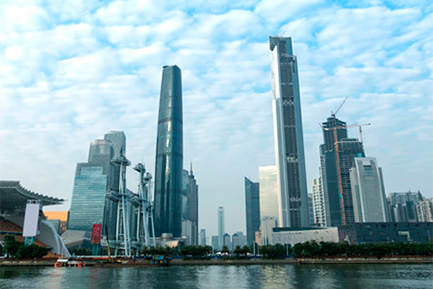
In recent years, emerging countries with rapidly growing economies have been facing population concentrations in urban areas. Against this backdrop has come the construction of multiple skyscrapers exceeding 300 meters tall. The tallest building in China's Guangzhou City, the Guangzhou CTF Finance Centre, was built in 2016 at a height of 530 meters with 111 above-ground and 5 below-ground floors. For this landmark tower, Hitachi delivered a world-class ultra-high-speed elevator capable of traveling at 1,200 meters per minute.
Sending the elevator the 440-meter distance from the first floor to the 95th in about 43 seconds required high-performance motors along with advanced technologies to optimally control them.
Enhancing comfort through vibration control and ensuring top-of-the-line safety were also essential. Hitachi made all of these possible through a series of technological developments and field tests at its own 213-meter G1TOWER, one of the world's tallest structures for elevator research.
Hitachi elevators are designed for comfort as well as speed. As Hitachi becomes more active in more parts of the world, it helps provide comfort in cities and buildings.
Finger vein authentication using smartphone camera
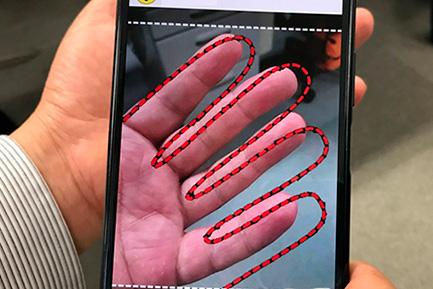
Shopping online with smartphones is now a major part of our lives, but at the same time more and more people are falling victim to unauthorized transactions. That's why in 2016, Hitachi developed technology for high-precision finger vein authentication using just the camera that comes standard in a smartphone instead of a conventional dedicated near infrared light sensor.
This image processing technology constructs a finger vein pattern by utilizing color information from multiple fingers photographed by the smartphone camera and emphasizing the portions that are particular to the veins. Authentication accuracy is achieved by distinguishing vein patterns from wrinkles on the skin surface. The combination of vein patterns from multiple fingers makes the system even more secure than conventional finger vein authentication.
In these times, when shopping can so easily be done from a smartphone, we must place a high priority on safety and security. Hitachi will continue to support people's everyday lives with its dependable security technologies.
As global competition intensifies, demand constantly changes, and customer needs become more diverse. Presented with these challenges, manufacturers in recent years have been required to achieve mass customization that delivers productivity equivalent to that of mass production, even in ultra-high-mix low-volume manufacturing.
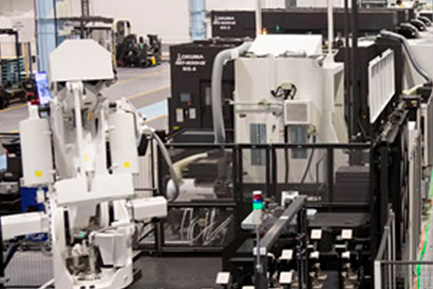
Okuma, a major machine tool manufacturer, wanted to combine the latest technologies such as automation and IoT with refined skills to provide the ultimate in manufacturing services that utilize the best qualities Japan has to offer.
Okuma and Hitachi have collaborated at Dream Site2, built in Aichi Prefecture of Japan in 2017, by applying the Lumada to implement programs designed to realize accelerating factory control cycles* and visualization for total optimization, based on the experience and expertise gained by both companies through years in manufacturing. By constructing a next-generation factory that is run through a combination of OT (control and operation technology) and IT (data analysis and utilization technology), they are moving forward to achieve mass customization.
*Accelerating factory control cycles: Accurately providing operation instructions that typically took days down to the hour or minute using IoT
Supplying High-speed Trains to the U.K., the Birthplace of Railways
In recent years there has been renewed interest in railway systems as an environmentally-friendly means of transport because they can efficiently and quickly move large numbers of passengers and goods. As a result, high-speed rail systems are now being proposed and built all over the world.
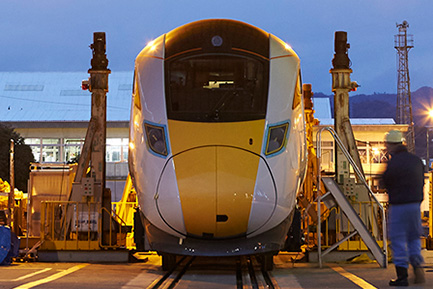
In the U.K., the birthplace of railways, construction of High Speed 1, the country's first dedicated railway system for high-speed service, began in 1998. Having already established a track record in providing rolling stock and systems for Japan's Shinkansen, Hitachi was awarded a contract for a fleet of 29 Class 395 trains, including a total of 174 train cars, for this railway in 2005.
Based on these achievements, in 2012 and 2013 Hitachi also received a contract for production and long-term maintenance work for a fleet of 122 of the new high-speed Class 800/801 trains, including 866 train cars, for the U.K.'s Intercity Express Programme. Most of these trains would be manufactured at the new plant in Newton Aycliffe that opened in 2015. Test runs are currently under way with service scheduled to begin in 2017.
With its railway service operations headquartered in the U.K. and manufacturing based in Japan, the U.K. and Italy, Hitachi will continue to provide high-quality railway service on a global scale.
Improving ATMs with Customers in Mind
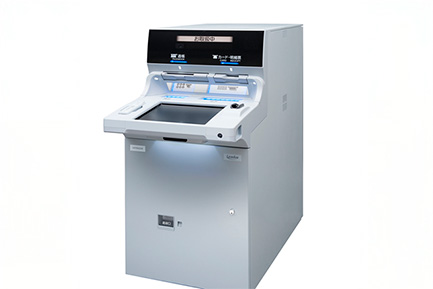
ATMs have developed and advanced with new trends and changes in society. ATMs are now available 24 hours a day, every day of the year, even at night and on holidays. And customers can use them not only at banks but also in convenience stores, shopping centers and various other places. ATMs have become an indispensible part of modern society.
Hitachi ATMs are designed from the customer's point of view for ease of use, comfort and convenience, including greater accessibility through universal design. Its newest model is the AKe-S, which naturally guides user operation using gentle lights and sounds. This ATM is designed for a wide range of users, including persons in wheelchairs or with color vision impairments. Improvements in design quality and performance along with boosts in banknote storage capacity keep it running for the long haul. It also includes security features for customer safety and peace of mind, and green considerations including energy efficiency.
Because they serve as a contact point for banks and customers, Hitachi will continue to improve its ATMs to make them even more user-friendly and secure. Hitachi will also continue to provide excellent global financial services and solutions with high added value, including the FinTech service that enables transactions on smartphones.
ATM: Automated Teller Machine
FinTech: A combination of the words "finance" and "technology." This term refers to innovations created through integration of finance and IT.
2018
Received orders signal and traffic management systems for high-speed trains in Italy
Hitachi and State Bank of India, the largest state-owned commercial bank in India, enter into Joint Venture to accelerate Digital Payments in India
2019
Launched "Lumada Solution Hub" to facilitate fast and easy integration of Lumada solutions
Developed a business-card-sized CMOS annealing machine that can be embedded in IoT devices
2020
Launched "Lumada Alliance Program" globally as a partnership program that accelerates open innovation to improve social, environmental and economic value, and QoL
Omika Works selected as the first Japanese factory to be a "Lighthouse" (advanced factory) by the World Economic Forum (WEF)
Acquired the power grids business from ABB of Switzerland and began operations as Hitachi ABB Power Grids Ltd. (later renamed Hitachi Energy Ltd.)
2021
Opened "Lumada Innovation Hub Tokyo," a flagship site directly connected to Tokyo Station, to accelerate Lumada movement through new co-creation in a post-COVID world
Developed EV charging technology with industry-leading compactness, lightweight design, and rapid charging for multiple vehicles
Hitachi Global Digital Holdings LLC (subsequently renamed Hitachi Digital LLC) acquired GlobalLogic Worldwide Holdings, the parent company of U.S.-based GlobalLogic, as a wholly owned subsidiary
2022
Innovative AI technology aids personalized care for diabetes patients needing complex drug treatment
2023
Developed "Worksite-Augmenting Metaverse" fusing worksite data-collection technology and generative AI
2026
Launched “HMAX”; a suite of next-generation solutions that brings the power of AI to social infrastructure.