



Governance and Resources
We are working to strengthen IT governance to ensure information security, IT compliance, and business continuity across the entire Hitachi Group.
In addition, We are accelerating IT resource reallocation, talent development, and the recruitment of diverse talent, and advancing the globalization of IT talent.
IT-BCP#1: Supporting Business Continuity through IT
To prepare for large-scale earthquakes, which are considered likely to occur in Japan, and natural disasters arising from global warming, as well as various other kinds of emergencies, such as pandemics and cyberattacks, we are formulating and operating IT-BCPs that enable us to support business continuity for the Hitachi Group through IT.
In addition, we are continually revising our plans so that we will be able to support the latest IT architecture.
Responding to disasters
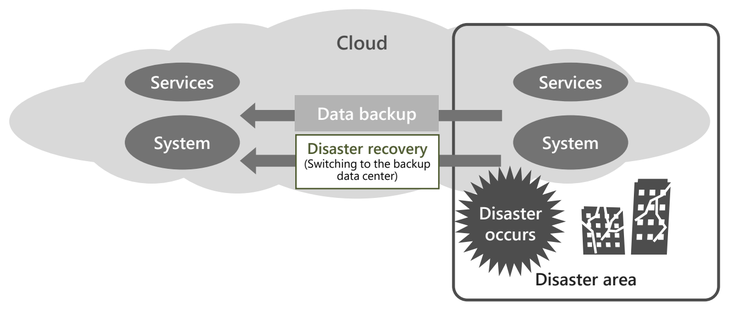
In response to new work styles, we established and improved our remote work environment. By using the remote work environment, we are able to continue our business even in the event of a pandemic.
In addition, to prepare for large-scale disasters, we clearly defined the desired state of IT from a BCP perspective: the BCP goals. Specifically, the three points are: (1) improving fault tolerance, including the development of disaster recovery environments through cloud migration; (2) ensuring the continuity of systems and services in the event of a disaster in Japan through the offshoring of operations; and (3) strengthening backup operations to ensure data protection. For these initiatives, we prioritize systems and services based on their impact on businesses that sustain essential social functions and implement the initiatives in stages. Through these measures, we will support the stable continuation of business.
Furthermore, we regularly conduct training based on these BCPs to strengthen preparedness for emergencies.
Responding to cyberattacks
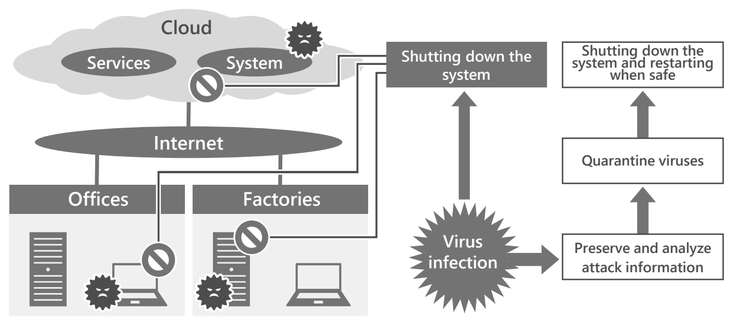
To address cyberattacks, we are implementing robust security measures by transitioning to a zero-trust architecture. In addition, anticipating a variety of cyberattacks, including ransomware, spear-phishing emails, computer worms, and unauthorized access to public-facing servers, we have established response procedures from initial response through recovery for each type of attack. These include isolating infected systems by disconnecting systems or preventing applications from launching, preserving and analyzing attack information, quarantining viruses, and disconnecting and reconnecting systems. As a result, we are working hard to ensure safe system operation and rapid recovery.
Furthermore, to firmly establish and improve our BCP, we regularly review our measures, conducting exercises based on anticipated cyberattack scenarios and the latest IT architecture, and preparing for new threats.
#1 BCP: Business Continuity Plan


